

Softee Oxel 2026
A tear-shaped hitter with a generous sweet spot, softened impact, and enough punch to finish without making defense feel like a chore.
Our Take
Shape
Tear
Weight
355 - 375 gr
Touch
Medium
Core
EVA Soft S8 foam
Faces
3K carbon
Frame
One-piece carbon
What we like
- Easy depth from baseline
- Broad, forgiving sweet spot
- Quick, penetrating net volleys
What we don't
- Lively exit limits touch
- Passive blocks can run deep
- Late contact loses direction
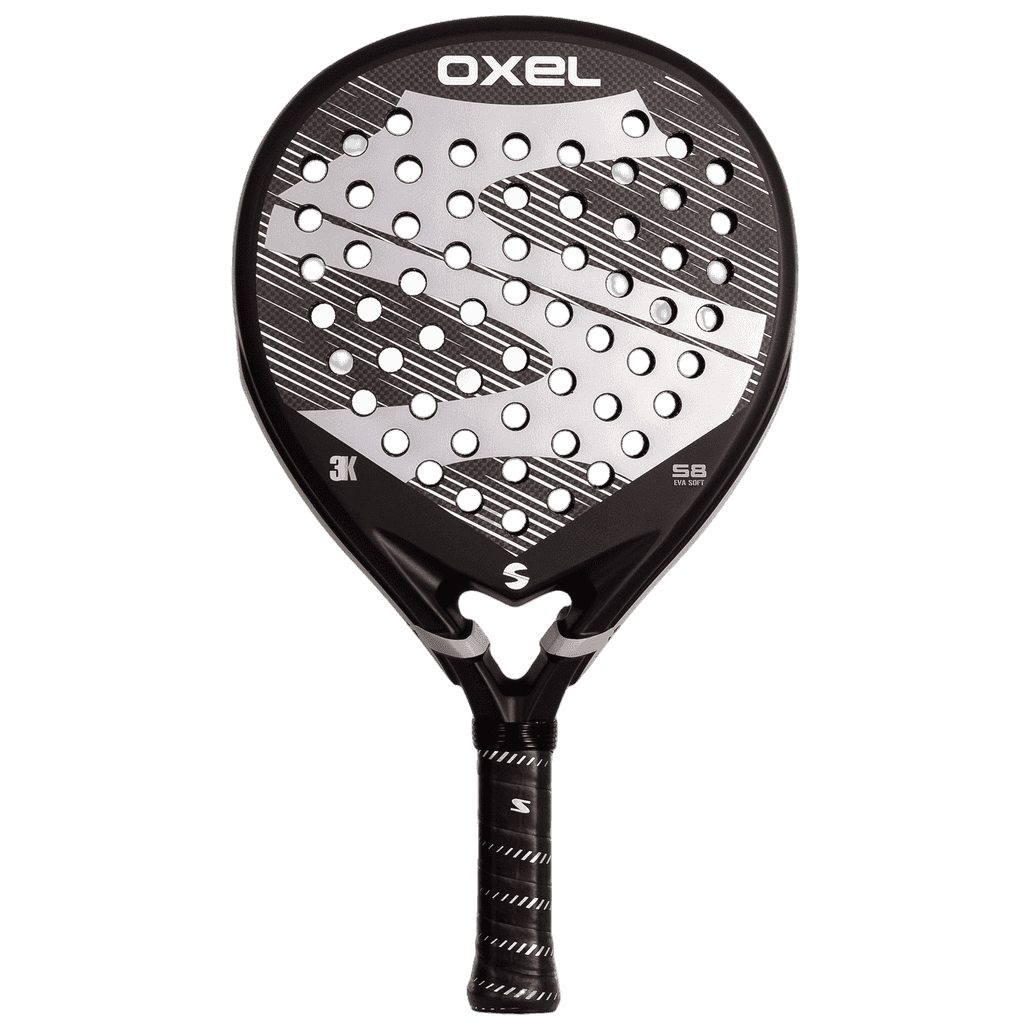
Softee Oxel 2026 is an attacking-minded racket that does not feel like a blunt instrument. It brings easy ball exit and a generous hitting area, but asks for a reasonably clean technique when the pace rises.
I see it fitting intermediate players who want more punch at the net without moving into an overly demanding, head-heavy racket. The response is lively rather than ultra-soft, despite the core choice.
Technical analysis
Shape & balance
The tear shape gives the Oxel a useful middle ground between maneuverability and attacking reach. It feels quicker through the air than a full diamond racket, while still putting enough mass behind the ball for aggressive volleys and overheads.
Softee has not made this into a defensive, head-light tool. The racket wants to move forward through the ball, particularly in quick exchanges, but it is not so top-loaded that it becomes slow in reaction blocks. I found that useful when changing from a defensive lob to taking the net, although players with compact swings may still need time to trust the longer attacking follow-through.
Its medium feel is also worth clarifying. The impact is not harsh, but it is firmer and more direct than I would expect from a racket marketed around a soft EVA core. Independent testing points in the same direction: comfort is decent, yet this is not a cushioned, low-effort racket for absorbing every heavy ball.
Materials & construction
A one-piece carbon frame, 3K carbon faces, and EVA Soft S8 core make for a construction that prioritizes response over a plush touch. The frame keeps the racket stable enough on firmer contact, while the 3K faces provide a clean, predictable release rather than the rigid, dry sensation of stiffer carbon layups.
Ball exit is one of its strongest traits. On medium-paced balls, I did not need to force the stroke to find depth. That can be a real advantage from the baseline, but it also means soft hands matter: if I got lazy on a block or drop shot, the ball could leave the face faster than intended.
The sweet spot feels broad for this type of racket, especially through the center and slightly above it. Still, that forgiveness should not be confused with automatic control. Off-center contact remains playable, but direction becomes less tidy when I am late.
On-court feel
Baseline play
From the baseline, the Oxel helps on defensive lobs and off-the-wall play because it supplies depth without demanding a huge swing. The response is lively, which made it easier to lift slower balls after the glass.
What it does not do especially well is slow the game down. Players who prefer to hold the ball on the face and place every low-driven lob with minimal rebound may find it a little springy. I had better results using a firmer wrist and a more deliberate preparation.
At the net
At the net, this racket makes sense quickly. Volleys come off with enough penetration to pressure opponents, and the maneuverability is good enough for fast exchanges close to the body. It also has enough bite for a controlled chiquita, though it is not a spin-focused face.
Blocks are effective when I meet the ball in front. If I simply present the racket passively against a hard volley, the strong rebound can send the ball too deep.
Bandeja and víbora
The Oxel rewards a committed bandeja and a faster víbora. It moves cleanly through the overhead path and gives enough output to keep opponents pinned without needing to overhit.
A flat smash has respectable finish, particularly when I accelerate properly, but this is not a pure power racket built around effortless winners from anywhere. Its strength is accessible attacking pace, not brute force.
Conclusion
I would choose the Oxel for an intermediate player who attacks often, likes a responsive racket, and wants help generating depth from both the baseline and the net.
The trade-off is control at low intensity. Its generous ball exit can work against touch shots, passive blocks, and players who rely on a very soft, dampened response. It is lively, forgiving through much of the face, and capable overhead—but it still needs disciplined hands.
What other reviewers say
- PadelRacketReviews.comen
This review positions it as a budget-minded attacking racket for intermediate players, with notably good power and competent maneuverability while the Soft EVA core takes some harshness out of impact. It still plays somewhat firm, with comfort, forgiveness, and control rated more moderately.
Switch Intelligence
Be the first to share where you switched from.
Community reviews
Real feedback from players who used this racket.
Add your review
To submit your review, log in first. You can still read all approved community reviews below.
Add review


