

Enebe Mustang Esmerald 15K 2026
A composed tear-shape that grips the ball cleanly, pairing generous rebound with the control to build points from the baseline.
Our Take
Shape
Tear
Weight
355 - 370 gr
Touch
Medium-Hard
Core
Professional EVA (Soft density)
Faces
15K Carbon
Frame
Carbon
What we like
- Generous exit on defensive blocks
- Stable baseline response under pressure
- Biting *víboras* and angled volleys
What we don't
- Smash needs clean acceleration
- Lively exit demands delicate touch
- Poor contact will not finish points
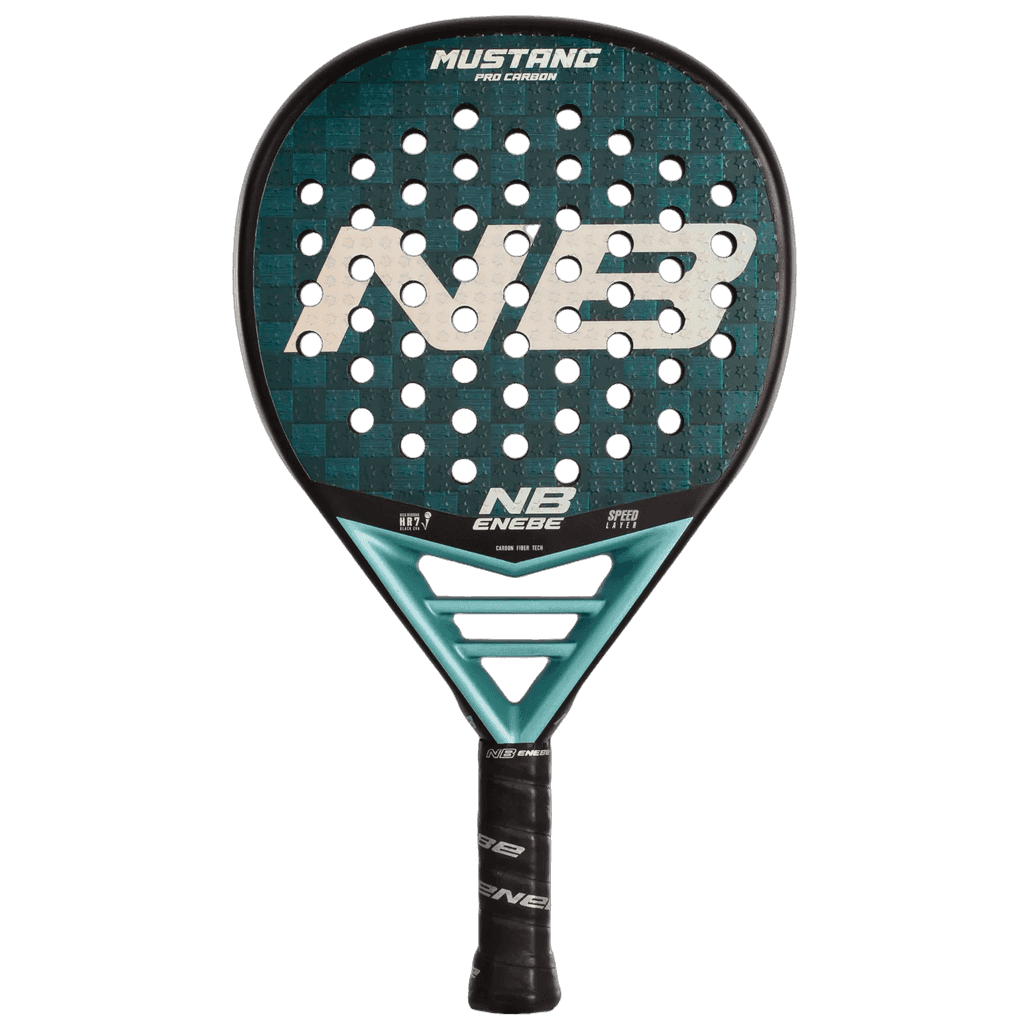
The Enebe Mustang Esmerald 15K 2026 is a controlled attacking racket with unusually generous ball exit. It does not chase brute-force finishing; it rewards players who build pressure through depth, spin, and clean placement.
I see it fitting an intermediate-advanced player who already has reliable timing and wants help from the racket in defense without moving to a soft, vague-feeling model. The response is lively, but not loose.
Its main limitation is clear from the outset: this is not the racket for effortless winners from poor contact. You still need to accelerate properly on overheads and find the center of the face.
Technical analysis
Shape & balance
The tear shape gives the Mustang Esmerald a broad enough working area for defensive shots while keeping more attacking intent than a round racket. Enebe lists a very high sweet spot rating, and that matches the profile: contact should feel forgiving across a larger part of the face than on a more demanding diamond.
I would expect a medium balance rather than a truly head-heavy setup. That helps it stay quick enough in hand for fast exchanges at the net, while still giving the head some presence on volleys and overheads. It should not feel as rapid as a head-light control racket, but neither should it drag through preparation.
Materials & construction
The 15K carbon faces, carbon frame, and Professional EVA soft-density core create an interesting contrast. The listed medium-hard feel should come more from the carbon structure and face response than from an excessively stiff core.
That combination explains the high rebound figure. The soft EVA should give the ball a useful push on blocks, defensive lobs, and off-the-wall play, while the 15K carbon keeps the response cleaner than a fiberglass-faced racket. I would not expect a dry, ultra-direct impact. Players who prefer a very firm, low-output racket may find the exit a little too eager until they adjust their touch.
On-court feel
Baseline play
From the baseline, this is where the Mustang Esmerald makes the strongest case for itself. Independent testing points to a stable, controlled response from the back of the court, and I can see why: the larger sweet spot and soft-density EVA should help the ball leave the face even when the defensive position is not perfect.
Blocks and compact countershots should come off with depth without requiring a huge swing. That is useful under pressure, particularly when returning fast volleys or playing a low-driven lob after the glass. The trade-off is that delicate drop shots need a quiet hand. With this much ball exit, overly relaxed contact can send the ball deeper than intended.
At the net
At the net, the racket looks more precise than explosive. The 15K face should provide enough firmness to punch volleys through the middle, while the reported grip on the face gives the player something to work with when carving angles or adding side spin.
I would use it to keep opponents low rather than trying to overpower them on every ball. It should be effective for controlled aggressive volleys, but it is not a sledgehammer for players who want the racket to finish short balls by itself.
Bandeja and víbora
This is likely its most satisfying attacking zone. Test feedback specifically highlights the face’s grip on spin-heavy volleys and víboras, and that makes sense with the 15K carbon surface and moderately firm response. The racket should let you cut under and around the ball without feeling disconnected at impact.
A well-timed bandeja should carry depth and control, while the víbora can be played with more bite and direction. On the smash, though, it is more about placement and a clean acceleration than raw power. Players looking for easy flat put-aways will find stronger options.
Conclusion
I would choose this racket for a developed player who values defense, spin, and a reliable response in transition to the net. It has enough attacking intent for purposeful overhead play, but its character is controlled pressure rather than all-out aggression.
The trade-off is simple: its lively core demands touch on slower balls, and its smash output depends on your technique. It gives plenty back, but it does not hide lazy preparation.
What other reviewers say
- BestPadelen
BestPadel’s test praises the face’s grip for spin-heavy volleys and víboras, alongside a stable, controlled response from the back of the court. It is not an extreme-power racket, but its medium feel gives balanced attacking output without giving up too much touch; it still asks for developed technique.
Switch Intelligence
Be the first to share where you switched from.
Community reviews
Real feedback from players who used this racket.
Add your review
To submit your review, log in first. You can still read all approved community reviews below.
Add review


