

Softee Speed 3.0 Royal Power 2026
A soft, forgiving teardrop shape that keeps the ball moving from the baseline, with enough punch to put away a short ball.
Our Take
Shape
Tear
Weight
355 - 375 gr
Touch
Soft
Core
Soft S8 EVA Foam
Faces
3K Carbon
Frame
100% Carbon
What we like
- Easy depth on compact swings
- Forgiving sweet spot on blocks
- Controlled *bandeja* with easy exit
What we don't
- Springy response against heavy pace
- Limited bite on *víbora* slices
- Slower reset in fast exchanges
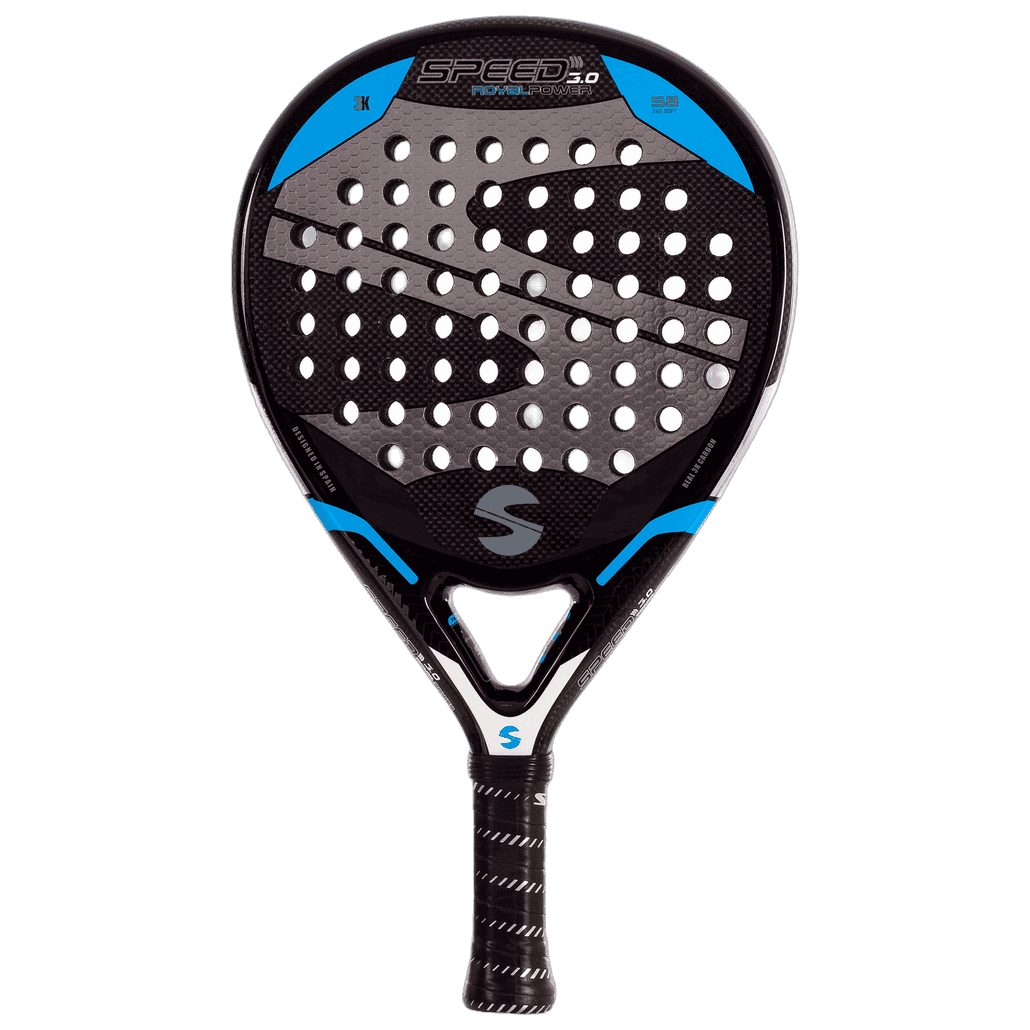
Softee Speed 3.0 Royal Power 2026 is a soft, fast-exiting racket built around easy depth and a generous margin for error. Its teardrop shape keeps it more balanced than a full attacking diamond, but there is still enough finish in the head to make overheads count.
I see it as a racket for intermediate players who want help from the core without giving up direction on volleys and defensive lobs. It does a lot of the work on slower swings.
That assistance has a limit. Players who generate their own pace and prefer a dry, compact response may find it too lively, especially in quick exchanges at the net.
Technical analysis
Shape & balance
The teardrop profile gives the Speed 3.0 Royal Power a broad, accessible hitting area. The sweet spot feels forgiving rather than overly concentrated, which matters on off-center blocks and hurried balls after the glass.
Its balance sits in the middle: enough head presence to accelerate a bandeja or finish a high volley, without becoming awkward when defending low. It is not a head-light racket that disappears in the hand, though. In long, fast exchanges, the head can feel a little slower to reset than a more defensive round-shaped model.
Materials & construction
Softee uses a 100% carbon frame, 3K carbon faces, and an EVA Soft S8 core. On court, that construction translates into a distinctly soft feel with very high ball exit. The racket compresses readily, then sends the ball away without needing a big swing.
The carbon structure keeps the response from becoming completely vague, but this is not a hard-carbon racket with a sharp, surgical impact. Touch shots need a relaxed hand. If I overplay a drop shot or a chiquita, the soft core can add more rebound than I intended.
On-court feel
Baseline play
From the baseline, this is where the racket makes the most immediate sense. Defensive lobs come off easily, and I can get depth from awkward positions without forcing the arm. Off-the-wall balls also benefit from that easy response; a compact swing is usually enough to send the ball back with useful length.
The trade-off is precision at higher pace. Against a heavy ball, the core can feel springy rather than completely planted. It rewards clean preparation, but players who like to absorb pace with a firmer face may want more resistance.
At the net
At the net, the broad sweet spot helps on reaction volleys and blocks. I can keep the racket stable enough through the ball while still getting a quick, deep reply. The soft response is especially useful when I am defending the body or trying to redirect a fast volley crosscourt.
Flat attacking volleys are less naturally punishing than with a harder, more head-heavy racket. The ball travels easily, but it does not produce that dense, crushing contact some aggressive players expect. I found it more effective for placement and sustained pressure than for ending every exchange with one swing.
Bandeja and víbora
The teardrop shape gives enough leverage for controlled overheads. My bandeja comes through with depth without needing to overhit, and the racket is forgiving if contact lands slightly outside the center.
A more aggressive víbora is possible, but the soft face does not provide the crispest bite or the most direct feedback on sliced contact. Players who build their game around sharp, fast overheads may prefer a firmer setup.
Conclusion
This is a forgiving, high-rebound racket for players who value easy depth, a large sweet spot, and a softer impact. It suits an intermediate game that needs support in defense and reliable response in transition toward the net.
The trade-off is clear: you gain ball exit and comfort, but lose some of the hard, exact response that advanced hitters use to control pace. It is not the racket I would choose for a player seeking maximum smash power, a very dry touch, or the quickest possible handling in rapid hand battles.
Switch Intelligence
Be the first to share where you switched from.
Community reviews
Real feedback from players who used this racket.
Add your review
To submit your review, log in first. You can still read all approved community reviews below.
Add review


