

Wilson Optix V2 Lite 2026
A light, soft round racket that makes defense and quick net exchanges feel easy, though its attacking ceiling arrives early.
Our Take
Shape
Round
Weight
350 - 360 gr
Touch
Soft
Core
Core Foam
Faces
Fiberglass Weave
What we like
- Quick hands in net exchanges
- Forgiving sweet spot on volleys
- Easy defensive lob ball exit
What we don't
- Smashes lack finishing punch
- Unstable against heavy incoming balls
- Limited bite on *víboras*


Updated on 1 Oct (shipping cost not calculated)
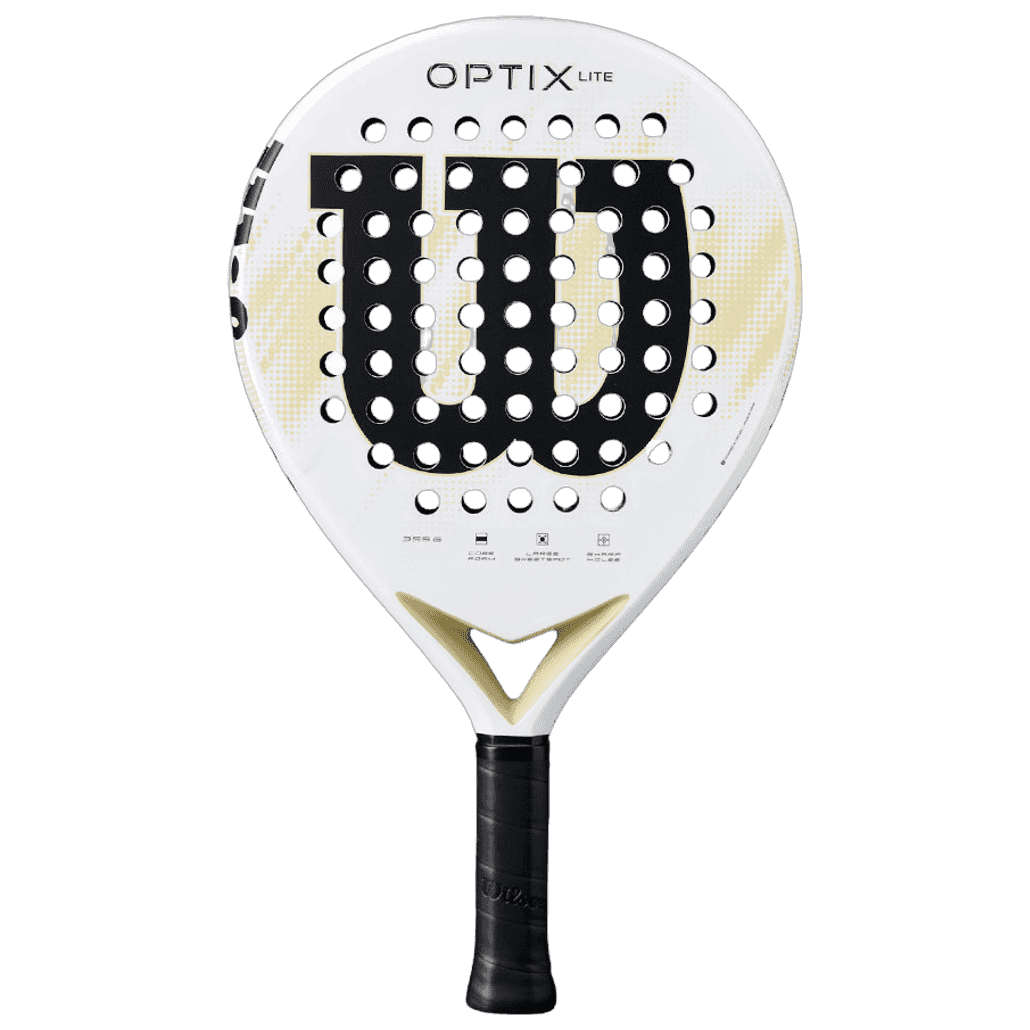
The Wilson Optix V2 Lite 2026 is a light, safety-first racket built around easy handling, soft contact, and a very forgiving response. It wants to keep you in the point rather than end it in one shot.
I see it fitting newer players, occasional competitors, and anyone who values a relaxed arm over a demanding, power-led setup. It is quick, comfortable, and uncomplicated—but there is a clear ceiling once the pace gets serious.
Technical analysis
Shape & balance
Its round shape gives the Optix V2 Lite a broad, accessible hitting area. The sweet spot feels generous through the middle of the face, so slightly late volleys and defensive contacts do not die as easily as they can with a more demanding racket.
The medium balance and light weight are a major part of its character. I found this type of setup especially useful in fast exchanges at the net, where getting the racket into position matters more than forcing extra pace. It also makes long sessions less tiring. The trade-off is stability: against a heavy volley or a fast ball coming off the back glass, the frame can get pushed around unless I meet the ball cleanly and firmly.
Materials & construction
Wilson uses Fiberglass Weave on the faces and a Core Foam core, producing a clearly soft feel. Contact is cushioned rather than crisp, with easy ball exit even when the swing is compact.
That soft construction helps a lot in defensive padel. I do not need a big preparation to send a lob deep or reset a difficult ball toward the middle. At the same time, the response is not especially precise when I try to flatten out a hard ball. The face gives help, but it does not offer the firm feedback or directional authority that stronger players often want.
On-court feel
Baseline play
From the baseline, this racket is very forgiving. Defensive lobs come off easily, and I can use a short swing to get useful depth when I am under pressure. It is also arm-friendly during repeated blocks and off-the-wall play, which matters for players still building confidence in defense.
The limitation appears when opponents speed up the point. Against heavy balls, the light frame does not always hold its line through contact. A controlled block works well, but trying to absorb pace passively can leave the ball shorter than intended. I would not choose it for a player who regularly faces hard-hitting opponents and wants a planted, stable feel.
At the net
Quick hands are this racket’s strongest argument. The light weight and medium balance make reaction volleys, compact blocks, and chiquitas easy to manage. I can adjust late without feeling like the head is dragging behind my hand.
It does not add much weight to attacking volleys, though. You can place the ball well and keep pressure with consistency, but finishing points through the opponent is harder. The smooth fiberglass face also offers modest bite, so players who rely on heavy cut or sharp angles may find their volleys and drop shots a little bland.
Bandeja and víbora
A controlled bandeja is comfortable because the racket gets through the swing quickly and does not punish imperfect contact. I would use it to maintain position and direct the ball, not to force a winner.
The víbora has less authority. There is limited spin assistance from the face, and the light build does not generate much natural penetration. Clean technique still matters more than the racket here.
Conclusion
The Optix V2 Lite suits players who want comfort, maneuverability, and easy ball exit above all else. It makes defense less stressful, helps at the net in quick exchanges, and gives plenty of tolerance across the face.
What you give up is attacking weight. Smashes lack real punch, aggressive overheads do not carry much menace, and fast opponents can expose its limited stability. It is a sensible racket for learning placement and extending rallies, but players developing a stronger attacking game may outgrow it fairly quickly.
What other reviewers say
- Padelvergleichde
The tester finds it notably maneuverable and less tiring over long sessions, particularly for quick net reactions, due to its light, low-balance setup. Its large sweet spot and soft feel help on imperfect contact, but smashes and aggressive bandejas lack pace.
- padel.howen
This review rates it highly for basic defense, compact lobs and resets, with a forgiving central hitting zone that produces useful depth without fast preparation. As pace rises, the light frame becomes less stable against heavy balls and the smooth finish offers limited spin help.
- PadelTestLaben
PadelTestLab characterizes it as a safety-first racket: arm-friendly, forgiving and lively enough to extend rallies while a player learns placement. That accessibility comes with a low ceiling for power and spin, so it falls short once the smash becomes a genuine weapon.
Switch Intelligence
Be the first to share where you switched from.
Community reviews
Real feedback from players who used this racket.
Add your review
To submit your review, log in first. You can still read all approved community reviews below.
Add review


