

Varlion Maxima Prisma Carbon Soft 2025
A firm, quick teardrop that rewards clean acceleration, bringing sharp direction and spin without the bulk of a diamond.
Our Take
Shape
Tear
Weight
345 - 360 gr
Touch
Hard
Core
SOFTCOLOR Core EVA 38 mm
Faces
Fiberglass + Carbon Carrera 20K
Frame
Prisma Frame (bidirectional carbon tubular)
What we like
- Quick recovery in net exchanges
- Precise blocks and low-driven lobs
- Strong bite on *víbora* shots
What we don't
- Defensive lobs need active acceleration
- Lateral off-center hits feel harsh
- Less automatic flat-smash power
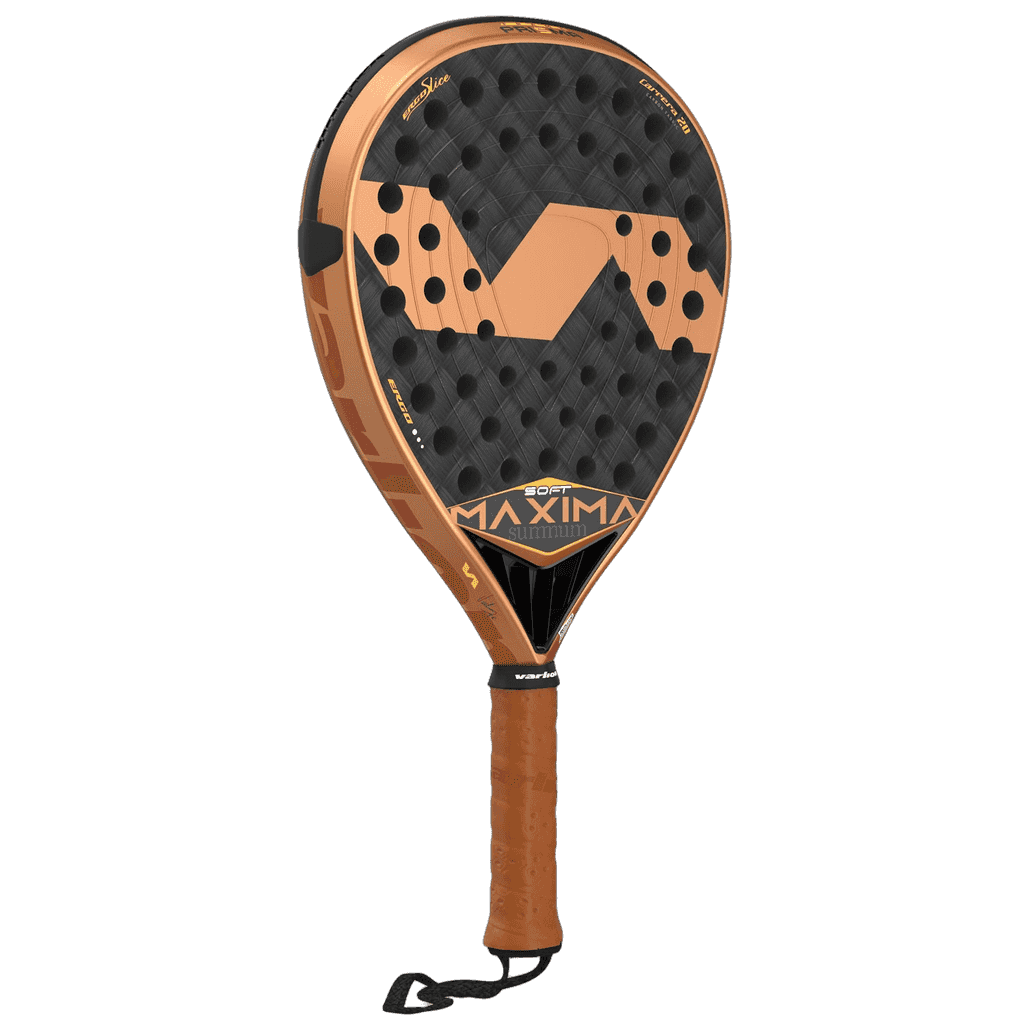
Varlion Maxima Prisma Carbon Soft 2025 is a firm, direct teardrop racket built for players who want to control the point without giving up a serious overhead game. I see it as an all-court option for an experienced player who creates pace rather than waiting for the racket to do it.
It moves faster than its solid construction suggests, especially in quick exchanges at the net. The trade-off is clear: it does not give away easy depth from difficult defensive positions.
Technical analysis
Shape & balance
The teardrop shape and medium balance give the Maxima Prisma a controlled attacking profile. It has enough mass through the head to make volleys and overheads meaningful, but it recovers quicker than a more demanding diamond racket. That matters when I am moving from a defensive block into a counterattack or reacting to fast hands at the net.
Its long handle is also useful. Players with a two-handed backhand will appreciate the extra room, while overhead players get a little more leverage through the swing. The sweet spot is reasonably generous for this shape, though it is not especially forgiving laterally. Miss toward the side of the face and the response becomes noticeably harsher.
Materials & construction
Varlion uses a Prisma carbon frame, faces combining fiberglass and Carrera 20K carbon, and a SOFTCOLOR EVA core. Despite the “Soft” name, this is not a soft, cushioned racket. The listed hard feel comes through as a medium-firm, fairly dry response: clear feedback, quick contact, and little unnecessary trampoline effect.
That construction gives the racket its directional control. On clean contact, I can place the ball accurately without feeling that the face is adding random lift or rebound. Ball exit is more measured than explosive, though. Players who rely on a very elastic face to bail them out will find it demanding.
On-court feel
Baseline play
From the baseline, the Maxima Prisma rewards active technique. It is quick enough to set up well on off-the-wall play, and I like the direct response for blocks, low-driven lobs, and controlled returns. When I meet the ball in front, depth is easy to judge.
Late contacts are another story. A low ball that catches me behind my body does not spring off the face with much help. I need to accelerate through it to find length, particularly on defensive lobs. This is more manageable than a head-heavy Bourne-style racket, but it is not a passive defender’s tool.
At the net
This is where the racket makes a strong case for itself. The maneuverability helps me reset the racket quickly between volleys, and the firm face keeps the ball from floating. I can play a compact block volley or press harder through the middle without losing much control.
The response also suits touch variations. Drop shots and a short chiquita feel precise because the face does not overreact, although the firm feedback means delicate shots need soft hands rather than a loose, forgiving contact.
Bandeja and víbora
The overhead game is one of its better areas. I get good bite on a bandeja and víbora, with enough control to work angles and enough pace to keep opponents pinned back. The long handle helps me accelerate cleanly, while the balance does not drag the racket through the recovery.
On a kick smash, spin is available if my technique is there. What it does not offer is effortless raw finishing power. A head-heavy diamond will still produce more automatic punch on flatter smashes.
Conclusion
I would put this racket in the hands of an upper-intermediate or advanced player who values a direct feel, quick net work, and controlled overheads. It suits someone who can generate their own acceleration and wants a racket that responds faithfully.
The main compromise is forgiveness. Off-center contact feels sharp, and defensive depth does not appear by itself. If you prefer a softer face, easy rebound, or maximum smash power, this is not the direction I would take.
What other reviewers say
- padel.howen
This test finds a firm, direct teardrop with strong directional control, effective volleys and particularly good spin on viboras, bandejas and kick smashes. It is more manageable defensively than a Bourne, but low, late or off-centre contacts require active technique and do not produce easy depth.
- Padelhosten
The review presents it as a quick, versatile option for advanced players: its medium balance and long handle help in fast transitions, volleys and two-handed backhands. Feel is described as medium-firm, supplying power when the player accelerates well rather than automatically delivering the punch of a more head-heavy diamond.
Switch Intelligence
Be the first to share where you switched from.
Community reviews
Real feedback from players who used this racket.
Add your review
To submit your review, log in first. You can still read all approved community reviews below.
Add review


