

Siux Trilogy 5 Pro 2025
A firm, round control racket that stays calm in defense, rewards clean placement, and asks your arm to earn the finish.
Our Take
Shape
Round
Weight
365 - 375 gr
Touch
Hard
Core
EVA Foam
Faces
Carbon
Frame
Carbon
What we like
- Broad sweet spot on blocks
- Predictable off-the-wall defensive exits
- Precise *bandejas* and sliced *víboras*
What we don't
- Little free smash power
- Passive defense can fall short
- Firm, dry ball exit
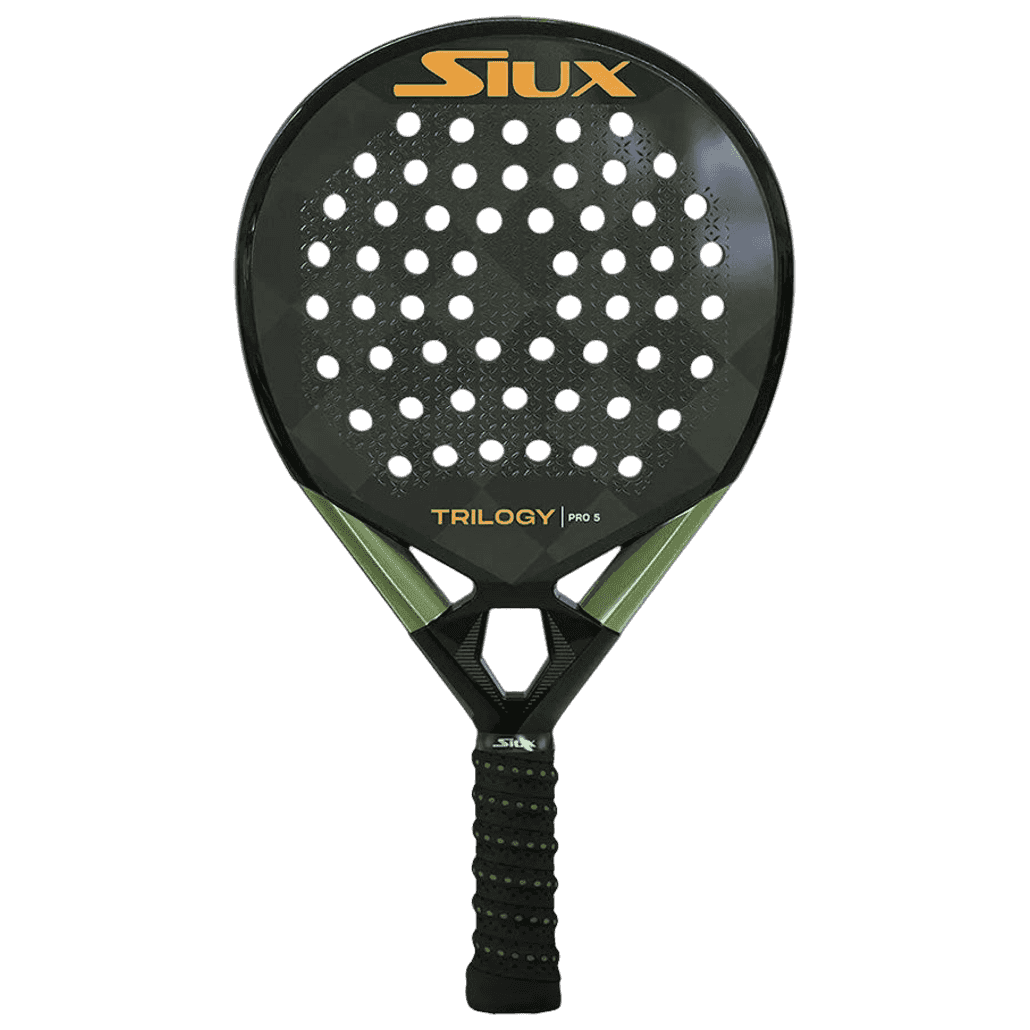
Siux Trilogy 5 Pro 2025 is a control racket with a firm, direct character and very little interest in doing the attacking work for you. It is built for players who construct points, defend with purpose, and value a clean response over easy finishing power.
Its round shape and hard feel make sense from the first few exchanges. The racket feels quick through the air, stable on contact, and more comfortable placing the ball than forcing it.
I would put it in the hands of an intermediate-to-advanced player with sound technique, particularly someone who spends plenty of time building from the baseline and using the net to create pressure rather than end every point with a smash.
Technical analysis
Shape & balance
The round mold gives the Trilogy 5 Pro 2025 a broad, central sweet spot. That matters most in defensive situations: blocks, rushed volleys, and off-the-wall returns do not need absolutely perfect contact to stay controlled. I found that forgiveness to be one of its strongest traits.
Its low balance also keeps the racket maneuverable despite the firmer construction. It comes around quickly for late defensive lobs and compact volley exchanges. The trade-off is clear, though: there is not much head assistance when you want to accelerate through the ball overhead. You have to create that speed yourself.
Materials & construction
The carbon frame and carbon faces produce a crisp, fairly dry response. Combined with the EVA core, the impact is firmer than a soft control racket and more connected to the ball. Players who like to feel the contact point will appreciate it; players wanting a cushioned, elastic ball exit may find it demanding.
The textured face is useful rather than decorative. It gives the ball enough bite for sliced volleys, controlled drop shots, and loaded overheads. I would not call it a spin machine, but it helps you shape the ball without needing an exaggerated swing.
On-court feel
Baseline play
From the baseline, this is where the racket earns its reputation. It is stable on blocks and very reliable when returning hard balls after the glass. The central sweet spot makes wall exits predictable, especially when you are defending under pressure and just need depth rather than a risky winner.
Ball exit is controlled, not explosive. That gives me confidence on low-driven lobs and chiquitas, because the racket does not suddenly fire the ball long. On the other hand, passive contact can sit short. You need to accelerate through defensive shots if you want real depth.
At the net
At the net, the low balance pays off. Quick volleys are easy to direct, and the frame stays composed when the pace increases. I liked it most for blocking hard drives and opening angles with compact movements rather than trying to hit through opponents.
There is enough firmness to play aggressive volleys, but not much free weight behind the ball. A player with good timing can still make the volley uncomfortable; someone relying on the racket to produce a heavy finishing ball will want more head-heavy mass and a livelier face.
Bandeja and víbora
This is arguably its most natural attacking area. The textured face and controlled response make the bandeja easy to place deep, while the víbora benefits from the racket’s quick handling and dependable slice. I could vary direction without feeling that the ball would jump unpredictably off the face.
Smash
The smash is the limitation. The Trilogy 5 Pro 2025 will not hand you easy power, particularly on flatter overheads or rushed contact. It rewards clean technique and full acceleration, but it does not provide the extra punch needed to turn average mechanics into an easy put-away.
Conclusion
I would choose this racket for control-oriented players who value defense, accurate volleys, wall play, and shaped overheads. It suits a player who likes to build the point patiently and take ownership of pace generation.
The trade-off is obvious: power is modest, and the firm response is not especially forgiving for players who prefer soft ball exit. If your smash is a major weapon and you want help finishing from mid-court, this is not the right Siux profile.
For disciplined players, though, it offers a very stable, agile platform that makes the difficult parts of point construction feel simpler.
What other reviewers say
- PadelTestLaben
The test finds it quick and stable on blocks, volleys and wall exits, with a broad sweet spot that helps under pressure. Its low balance and textured face suit bandejas, sliced viboras and defense, but smashes require technique because the racket supplies no free power.
- PadelSapienses
This assessment places it firmly in the control category: it stands out for handling, baseline play and wall exits thanks to a large, central sweet spot. The 3D finish helps on spin volleys and sliced shots, while put-away smashes need to be generated by the player.
- Reddit r/Padelracketen
An owner describes it as very light with a pleasingly firm feel, but noticeably short on power compared with more forceful rackets. The same player also questions its value and build quality.
Switch Intelligence
Be the first to share where you switched from.
Community reviews
Real feedback from players who used this racket.
Add your review
To submit your review, log in first. You can still read all approved community reviews below.
Add review


