

Siux Diablo Pro SE 2026 Tino Libaak
A firm, spin-friendly teardrop that rewards fast hands and clean mechanics, bringing attacking intent without abandoning the back court.
Our Take
Shape
Tear
Weight
365 - 375 gr
Touch
Medium-Hard
Core
EVA Foam
Faces
24K Textreme Carbon
Frame
Carbon
What we like
- Heavy, directed attacking ball
- Useful bite on *víboras*
- Stable, precise net blocks
What we don't
- Restrained ball exit defensively
- High sweet spot demands contact
- Overheads require racket-head speed


Updated on 15 Oct (shipping cost not calculated)
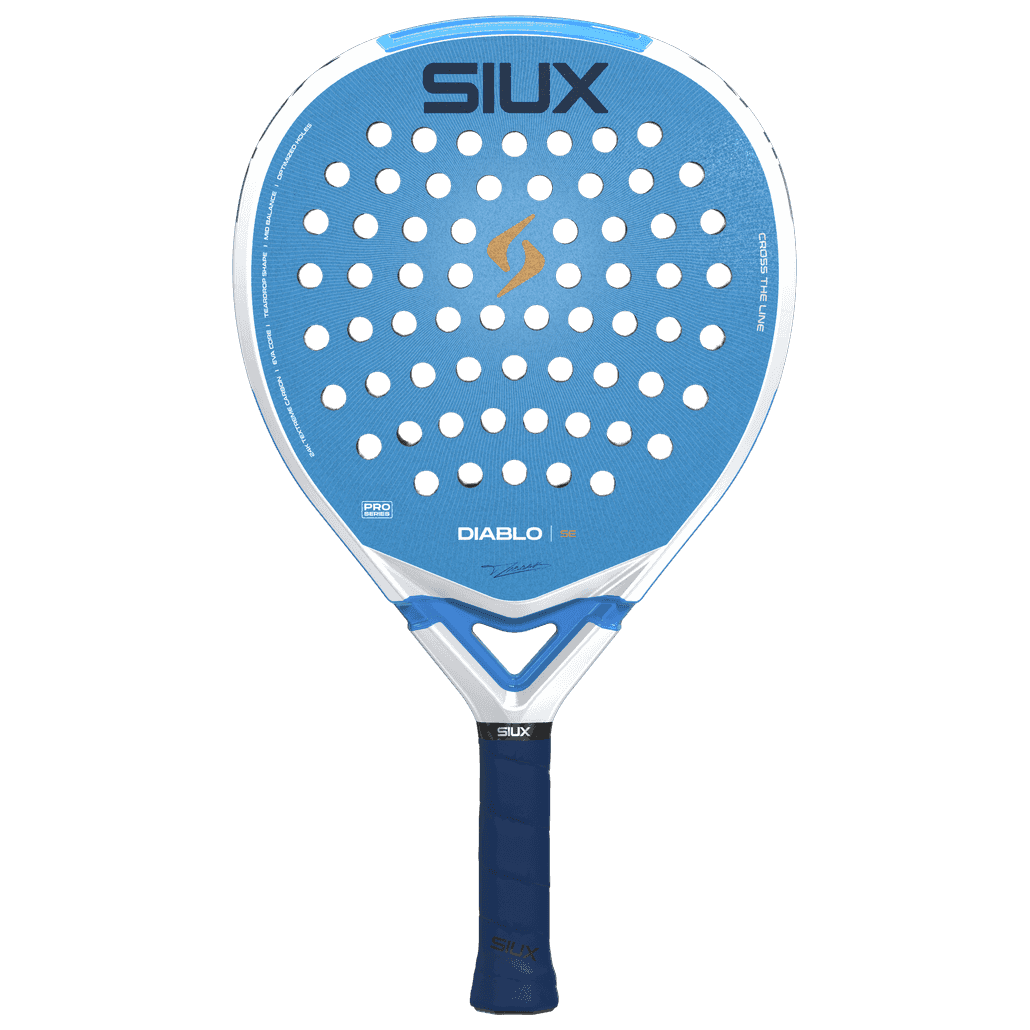
Siux Diablo Pro SE 2026 Tino Libaak is an attacking racket with enough control to avoid feeling one-dimensional. It wants a player who accelerates through the ball, uses spin with intent, and is comfortable taking responsibility in transition and at the net.
I found it more demanding than forgiving. The response is firm, the ball exit is measured rather than automatic, and lazy contact is not rewarded. Give it clean technique, though, and it produces a very heavy, directed ball.
Technical analysis
Shape & balance
The tear shape gives this racket a more usable hitting area than a pure diamond, while keeping enough mass toward the head to make overheads and attacking volleys count. Its sweet spot is not tiny, but it sits high enough that contact quality still matters, especially under pressure.
Maneuverability is good for this type of racket. I could get the head through quickly on fast exchanges, but it does not have the effortless handling of a head-light control racket. Players who arrive late to the ball at the baseline may find it a little unforgiving.
Materials & construction
The Carbon 24K Textreme faces and carbon frame produce a compact, direct impact. This is a medium-hard feel: firm enough to give clear feedback and solid energy transfer, without becoming completely dry on slower shots.
The EVA core contributes to that controlled response. There is no exaggerated trampoline effect, which helps when blocking hard volleys or playing a low-driven lob. On the other hand, players who rely on the racket to lift defensive balls with minimal swing will need to work harder than they would with a softer fiberglass-faced model.
On-court feel
Baseline play
From the back, the Diablo Pro SE is more capable than its attacking profile suggests. The tear format provides enough margin on defensive lobs and off-the-wall play, provided I prepare early and strike through the ball rather than just presenting the face.
Its ball exit is restrained. That can be a benefit when I want to keep a block low or control depth, but it is not a racket that rescues poor timing. Short, passive defensive shots can die in the court if I do not add my own acceleration.
At the net
At the net, it feels purposeful. Volleys come off with a dense response and enough stability to press the opponent without overhitting. The firm face also makes direction changes clear, particularly on compact backhand blocks and drop shots played from an aggressive position.
The rough finish earns its place here. It gives noticeable bite on brushed contact, helping me keep the ball down or pull it away from the fence. That texture will not create spin by itself, but players with a clean brushing action will get useful grip from it.
Bandeja and víbora
This is one of its stronger areas. The racket’s head presence and rigid faces let me drive a víbora with pace and side spin, while the surface helps hold the ball briefly enough to shape it. It also stays composed through a firm bandeja when I want depth rather than outright speed.
A full smash has plenty of punch, but it asks for racket-head speed. It is not a free-power racket for players with a short or hesitant overhead motion.
Conclusion
I would put this in the hands of an intermediate-advanced or advanced player who attacks with spin, likes a firm response, and wants a racket that can still defend without becoming soft or vague.
The trade-off is clear: it offers precision and strong attacking output, but not easy ball exit or maximum forgiveness. Players seeking a softer touch, a lower balance, or help on late defensive contact should look elsewhere.
What other reviewers say
- PadelRacketReviews.comes
The review places it firmly on the power side: the rigid face transfers energy strongly, while the rough finish helps generate spin on brushed shots. Despite its attacking emphasis, the teardrop shape retains a usable hitting area, but the firm response demands sound technique and racket-head speed.
- PadelSapienses
Its assessment describes a high-performing all-court racket, with power, control, rebound, and maneuverability all rated at a very similar level. It stands out particularly for spin and víboras, while still performing well on wall-drop shots and from the back of the court.
Switch Intelligence
Be the first to share where you switched from.
Community reviews
Real feedback from players who used this racket.
Add your review
To submit your review, log in first. You can still read all approved community reviews below.
Add review


