

Sane Agressor Evolution Gold 2026
A firm teardrop built for decisive overheads, crisp blocks, and biting slice, asking clean timing when defense gets rushed.
Our Take
Shape
Tear
Touch
Hard
Core
PRO HD-R
Faces
15K 2-to-1 Carbon
What we like
- Powerful committed-contact smashes
- Biting sliced bandejas and víboras
- Firm, direct blocking volleys
What we don't
- Limited defensive ball exit
- Narrow sweet spot demands accuracy
- Harsh vibration on off-center hits
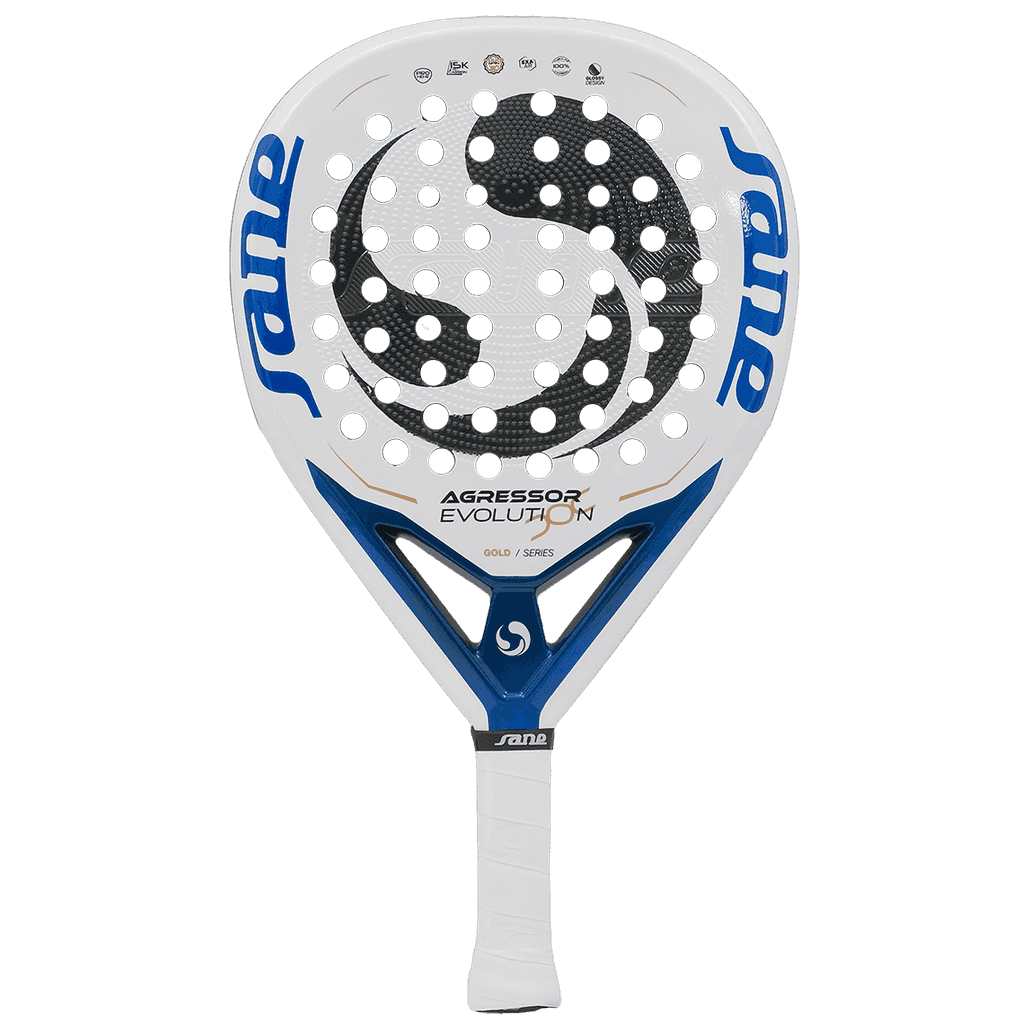
The Sane Agressor Evolution Gold 2026 is a firm, attack-minded racket with enough shape discipline to avoid feeling one-dimensional. It wants clean contact and an active swing; in return, it gives you a crisp hit, serious overhead output, and a very direct response at the net.
I see it for established intermediate-to-advanced players who build points with pressure rather than waiting for easy ball exit. This is not a forgiving defensive racket, and it does not hide late preparation.
Technical analysis
Shape & balance
Its teardrop shape gives the Agressor Evolution Gold a hybrid character: there is more control and handling than I would expect from a full diamond, but the racket still clearly favors attacking strokes. The sweet spot is reasonably placed for transition play and overheads, though it is not especially broad.
Balance feels geared toward putting weight through the ball rather than flicking the racket around in frantic exchanges. That helps when I want to drive a volley deep or accelerate through a bandeja, but it also means I need to prepare early at the net. In very fast hand battles, it is less nimble than a more head-light control racket.
Materials & construction
The 15K 2-to-1 Carbon faces and PRO HD-R core produce a distinctly hard feel. Contact is crisp, compact, and fairly low in free trampoline effect. I get a clean sense of where I have struck the ball, which is useful when shaping slices or directing blocks, but poor centering is not forgiven.
That firm construction also explains the racket’s strong attacking response. It stays stable when I hit through the ball and does not feel vague on quick volleys. The trade-off is vibration on off-center contact. Players with inconsistent timing or sensitivity to a harsher response should take that seriously.
On-court feel
Baseline play
From the baseline, I get precision when I create my own acceleration. Defensive lobs can be accurate, and a low-driven lob comes off cleanly when I meet the ball in front. Off-the-wall play is more demanding, however. The racket does not give much easy ball exit, so passive blocks or late recovery shots can land short unless I drive through them.
This is where its demanding side shows most clearly. I would not choose it for a game based on absorbing pace and letting the racket do the work.
At the net
At the net, the Agressor feels much more at home. Firm blocking volleys come off fast and direct, with enough stability to keep the ball low when opponents hit hard at my body. It is particularly effective when I step into a volley and use the face to press the opponent back.
Quick exchanges require anticipation. The response is sharp, but the racket does not turn as effortlessly as a lighter-handling option.
Bandeja and víbora
This is one of its better areas. The hard face gives sliced bandejas a controlled, biting trajectory, while the víbora benefits from the racket’s direct response and ability to carry pace through the ball. I can vary depth without the ball floating excessively.
Smash
The smash is the headline shot. With sound technique and a full acceleration, the racket produces clear power and a satisfying, solid impact. It rewards committed contact; it will not manufacture the same result from a lazy or late swing.
Conclusion
I would put the Agressor Evolution Gold in the hands of a player who already centers the ball consistently and wants a firm racket for volleys, sliced overheads, and finishing smashes.
The trade-off is comfort. Defensive ball exit is limited, the sweet spot asks for accuracy, and off-center hits can feel harsh. If I want a racket that helps me defend effortlessly, this is not the one. If I want to take initiative and hit with intent, it makes much more sense.
What other reviewers say
- Padel Test by Roberto Cardiit
This test positions it as a notably powerful yet well-rounded hybrid, using its rounded teardrop shape to balance control with attacking output.
- PadelTestLabes
It stands out for its crisp response, strong smashes and quick blocking volleys, with particularly effective bite on viboras and sliced bandejas. In return, defensive ball exit is limited, the sweet spot demands accuracy, and off-centre contact sends noticeable vibration through the racket.
- AvisPadelfr
It rates the racket as a balanced advanced-level option whose main asset is power, while retaining enough control for measured bandejas and transition shots. It performs capably at the net, but demands anticipation in very fast exchanges and is less forgiving for players without established technique.
Switch Intelligence
Be the first to share where you switched from.
Community reviews
Real feedback from players who used this racket.
Add your review
To submit your review, log in first. You can still read all approved community reviews below.
Add review


