

Joma Hyper Pro HRD 2026
A firm diamond built for clean, committed attacks, rewarding fast hands and punishing lazy contact from the back court.
Our Take
Shape
Diamond
Weight
355 - 365 gr
Touch
Medium-Hard
Core
Black EVA HRD
Faces
12K Carbon
Frame
Dual Tech Frame
What we like
- Stable, forceful drive volleys
- Direct power on clean smashes
- Textured face adds overhead bite
What we don't
- Demanding sweet spot on defense
- Limited rebound on slow swings
- Firm feel can transmit vibration


Updated on 26 Oct (shipping cost not calculated)
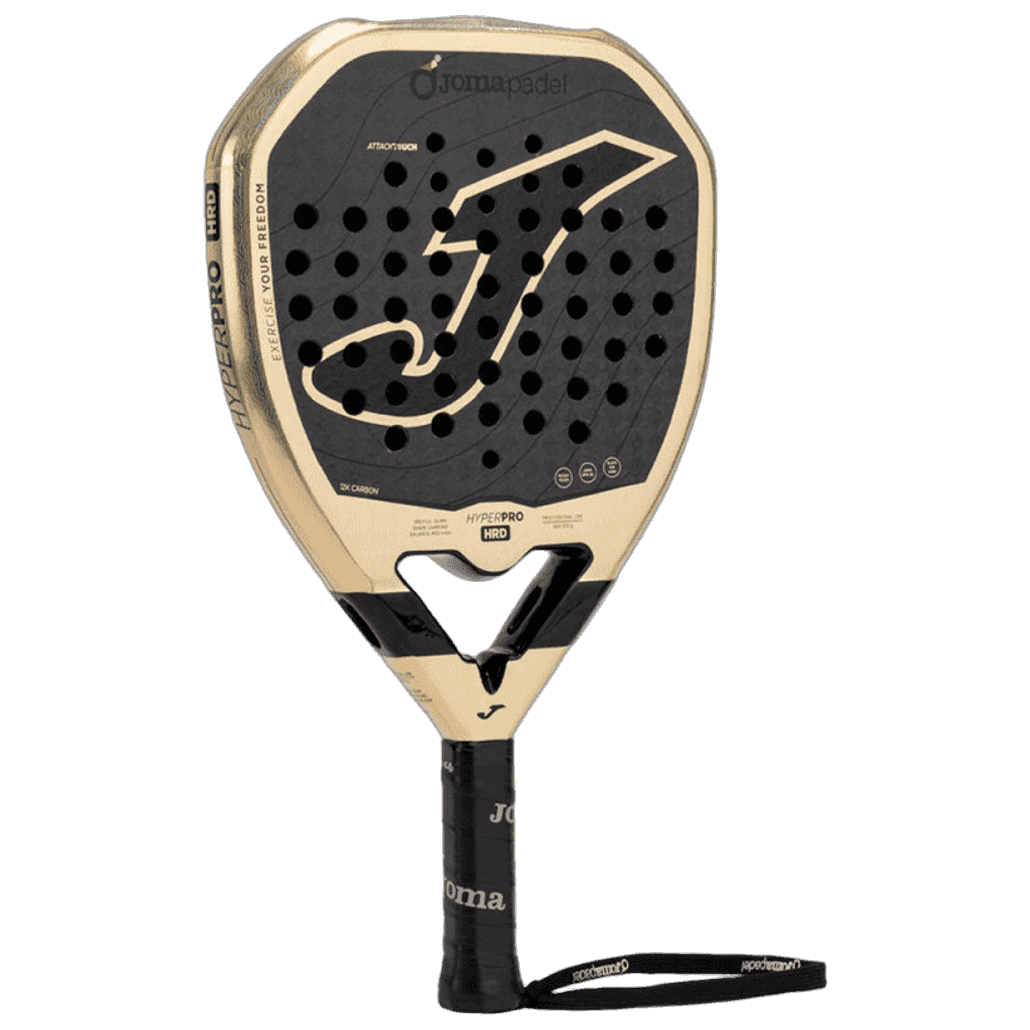
Joma Hyper Pro HRD 2026 is an attacking racket with a blunt, direct personality. Its Diamond shape, moderately high balance, and Medium-Hard feel want you moving forward, accelerating through the ball, and finishing points rather than waiting for free ball exit.
I found it most convincing in quick offensive exchanges. Clean contact feels solid and connected, but this is not a racket that quietly fixes late preparation or poor positioning.
Technical analysis
Shape & balance
The diamond mold places the useful hitting area slightly higher in the face, so the racket naturally favors overheads, aggressive volleys, and attacking drives. It feels stable through contact, particularly when I am taking the ball early at the net or loading up a flat smash.
That stability comes with a cost. The sweet spot is not especially generous, and the balance asks for purposeful racket-head speed. On a rushed defensive lob or a contact near the upper edge, the response drops off quickly. I would not call it cumbersome, but it is less maneuverable than a rounded, head-light control racket.
Materials & construction
The Dual Tech Frame, 12K Carbon faces, and Black EVA HRD core produce a firm, crisp response. There is very little trampoline effect. On clean contact, energy transfer is efficient and the ball leaves with a direct, heavy trajectory; on imperfect contact, though, the frame lets you know about it.
The textured face also has a real effect rather than being decoration. I could get useful bite on sliced volleys and topspin shots, especially when shaping the ball rather than simply punching it flat. Comfort is not its strength. The hardish core and compact response can send some vibration into the arm over a long session, particularly if you defend a lot from awkward positions.
On-court feel
Baseline play
From the baseline, I had to supply the pace. The Hyper Pro HRD does not give much free rebound on slow swings, low pickups, or off-the-wall play. Blocks can be accurate if I meet the ball in front, but passive defense feels demanding because the racket does not help much when the ball catches me late.
That said, the direct response is useful for low-driven lobs and controlled counterattacks. I could place the ball well when my preparation was clean. Players who rely on easy depth from a softer core may find it unforgiving.
At the net
This is where the racket makes most sense. Drive volleys come off firm and stable, with enough mass through the ball to keep opponents pinned behind the service line. It does not feel twitchy when absorbing pace either, provided contact lands near the center.
Touch shots need more care. A soft drop shot or chiquita can sit up if I do not soften my hand, because the face wants to return a fairly direct ball. It rewards decisive technique more than improvisation.
Bandeja and víbora
The textured carbon face works well for a spin-heavy bandeja and an aggressive víbora. I could carve the ball with confidence and keep a lower, more biting trajectory than with a smoother-faced racket. The firm response also helps when I want to drive the overhead instead of floating it.
On the other hand, off-center overheads are noticeably punished. A late contact does not retain much pace or direction, so this is not the racket I would choose for saving poor positioning under pressure.
Conclusion
I would put the Hyper Pro HRD 2026 in the hands of an intermediate-advanced or advanced player whose game is built around taking the net, hitting through volleys, and attacking with the smash. It has the stability, directness, and spin access for that style.
The trade-off is clear: less assistance in defense, a smaller effective sweet spot, and a firmer feel that can become tiring. If you want easy ball exit and comfort from the baseline, look elsewhere. If you can create racket-head speed consistently, this one gives your attacking shots a serious, honest response.
What other reviewers say
- PadelTestLabes
This test finds a very crisp, direct response that rewards flat smashes, por-tres overheads and spin-heavy víboras. The trade-off is that it demands racket-head speed: defense, lobs, and low or off-center contacts lose output and send vibration into the arm.
- PadelVerdicten
The review positions it squarely as an attacking racket: it stays stable and forceful on smashes and drive volleys, while the textured face adds useful spin. Its balance and medium-hard feel reduce comfort and forgiveness, so off-center contact is punished and long sessions can become tiring.
- PadelRacketReviews.compt
This review rates the racket as reasonably balanced, but says its smash power is less exceptional than its profile implies. It also flags punished off-sweet-spot overheads and an unremarkable handle response over extended sessions.
Switch Intelligence
Be the first to share where you switched from.
Community reviews
Real feedback from players who used this racket.
Add your review
To submit your review, log in first. You can still read all approved community reviews below.
Add review


