

Head Bolt 2025
A soft, forgiving tear-shape racket that calms the back court, then moves quickly enough to keep life simple at the net.
Our Take
Shape
Tear
Weight
350 - 360 gr
Touch
Soft
Core
Power Foam
Faces
Fiberglass
Frame
Power Frame
What we like
- Easy depth on defensive lobs
- Forgiving sweet spot on blocks
- Quick handling in net exchanges
What we don't
- Limited bite on *víboras*
- Vague response on flat drives
- Lacks repeatable *por tres* power
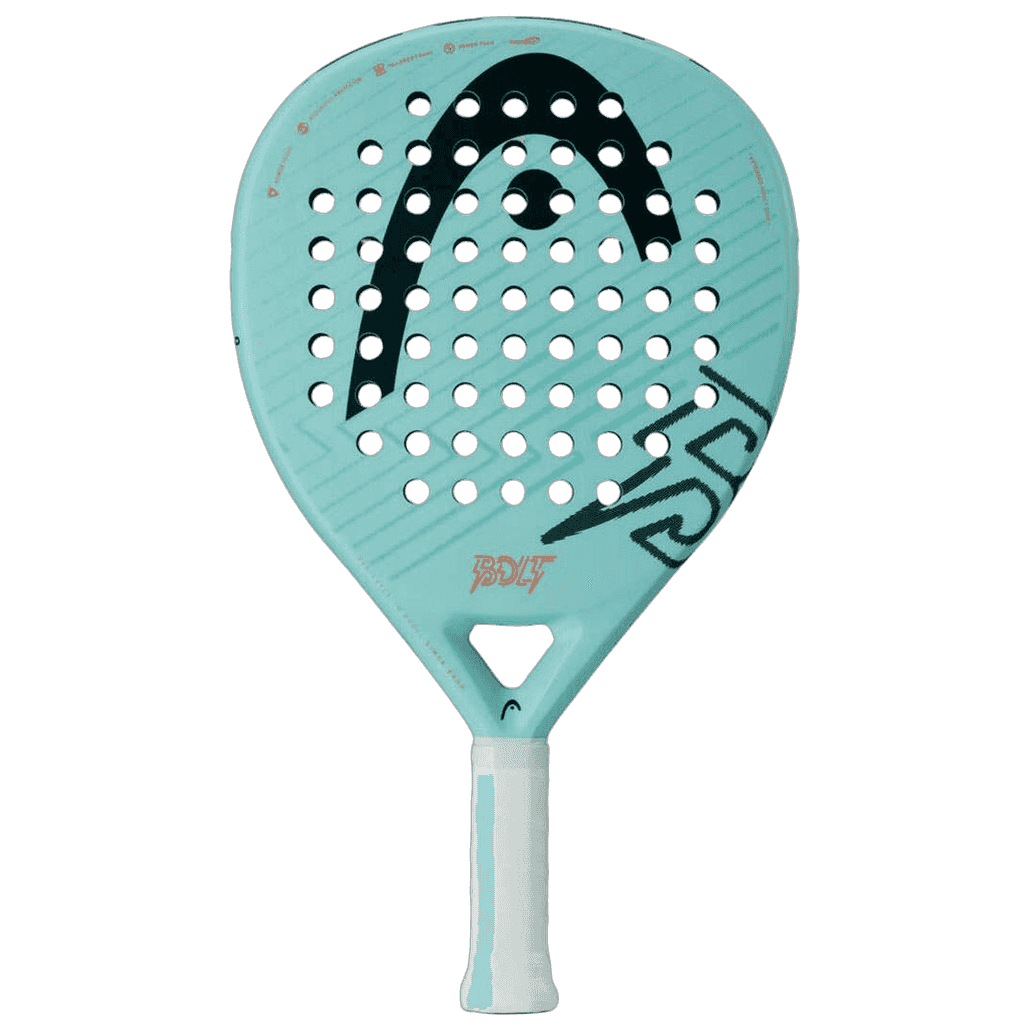
Head Bolt 2025 is a soft, forgiving racket built around easy depth rather than point-ending force. I see it as a comfortable option for club players who want help from the baseline, a generous contact zone, and a response that does not punish every late hit.
It is not a carbon racket pretending to be soft. Its character is clearly dampened, easygoing, and quick through the air.
Technical analysis
Shape & balance
The tear shape gives the Bolt a useful middle ground between a round control racket and a more demanding diamond model. Its balance feels manageable rather than head-heavy, which is a big reason it moves so easily in defensive exchanges and quick reactions at the net.
I found the sweet spot to be broad for this category. Contact outside the center still produces a usable ball, especially on blocks and returns where I am more concerned with getting the ball deep than hitting a clean winner. That forgiveness is one of its strongest traits.
Materials & construction
Head combines a Power Frame, fiberglass faces, and a Power Foam core. The result is a distinctly soft feel with plenty of ball exit. The racket compresses the ball easily, so I do not need a big swing to send a defensive lob toward the back of the court.
That comfort comes with a trade-off. Fiberglass and foam mute vibration nicely, but they also remove some of the crisp feedback I get from firmer carbon faces. On hard, fast contacts, the Bolt feels less precise and less immediate than a racket aimed at advanced players.
On-court feel
Baseline play
From the baseline, this racket does much of the work for me. Defensive lobs come off the face with easy height and depth, while off-the-wall shots do not need much acceleration to clear the net safely. It is especially helpful when I am stretched, late, or forced to block a hard ball back into play.
The soft response is forgiving, but it can become slightly vague if I try to play very flat, aggressive drives into tight spaces. I can place the ball well enough, yet I do not get the same sharp, surgical response that a firmer face provides.
At the net
Its maneuverability stands out in quick exchanges. I can get the racket into position quickly for reflex volleys and compact blocks, and the soft face helps absorb pace rather than sending the ball too long. For a player still building confidence at the net, that is useful.
Against very fast opponents, though, the response is not particularly crisp. The Bolt handles pace, but it does not give me the firm punch needed to consistently take over rapid volley exchanges.
Bandeja and víbora
The smooth face limits the racket’s bite. I can play a controlled bandeja with decent depth, but generating heavy spin or a sharply dipping víbora takes more work from my technique. The ball leaves cleanly, not aggressively.
That makes it reliable for keeping the net, but less convincing for players whose overhead game depends on carving angles and loading the ball with spin.
Smash
On favorable balls, the Bolt can put away a standard smash. It has enough accessible power to finish short lobs or force a weak reply without requiring a huge swing.
What it does not have is repeatable por tres authority. Players who expect their racket to help them lift the ball out with regularity will find the ceiling quickly.
Conclusion
I would choose the Bolt for a developing or intermediate player who values comfort, easy ball exit, and defensive tolerance. It is particularly convincing for deep lobs, blocks, and recovering difficult balls from the back court.
The trade-off is clear: less crispness, less spin, and less finishing power than a carbon-focused racket. It helps me stay in points; it does not naturally turn me into an aggressive finisher.
What other reviewers say
- PadelTestLaben
It stands out for easy ball output, deep lobs and forgiveness in defense, including on off-center contact. Its smooth surface and soft response limit spin and finishing authority on víboras and por tres smashes.
- Padel Racket Storeen
The review presents it as a comfortable, forgiving racket that supplies accessible power without heavily punishing mistakes, making it suitable for progressing in club play. Against more demanding carbon rackets, it gives up crispness, spin and some speed in very fast net exchanges.
- AvisPadelfr
The analysis particularly rates its maneuverability, broad sweet spot and ease in sending deep returns from the back court. Smashes work on favorable balls, but it lacks the punch to routinely finish points with a por tres smash.
Switch Intelligence
Be the first to share where you switched from.
Community reviews
Real feedback from players who used this racket.
Add your review
To submit your review, log in first. You can still read all approved community reviews below.
Add review


