

Dunlop Galactica OS 2025
A composed round racket with a broad sweet spot, built to place the ball precisely and keep hurried exchanges under control.
Our Take
Shape
Round
Weight
360 - 375 gr
Touch
Medium-Hard
Core
EVA Pro
Faces
3K Carbon (Tri-Max)
What we like
- Stable off-center volley blocks
- Quick reactions in net exchanges
- Controlled *bandeja* and *víbora* bite
What we don't
- Restrained ball exit on pickups
- Flat smashes lack natural inertia
- Firm response demands clean contact
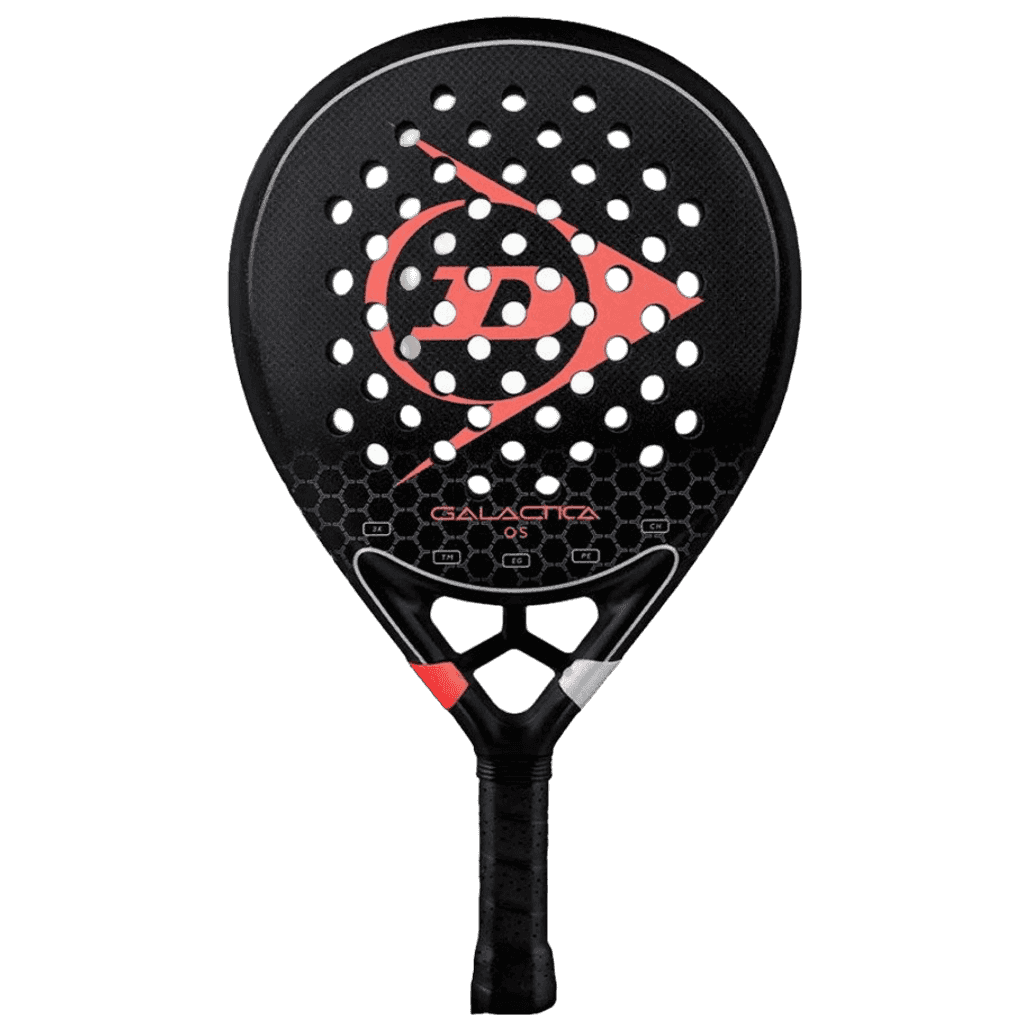
The Dunlop Galactica OS 2025 is a control-first round racket with a quick, stable character. It wants to help you build the point, hold your position in fast exchanges, and place the ball with intent rather than end rallies through easy power.
Its medium-hard response is direct without feeling brutally stiff, but it does ask for clean contact. I’d put it in the hands of an intermediate-to-advanced player who values consistency from the baseline and sharp work at the net more than effortless smash output.
Technical analysis
Shape & balance
The round shape and low-to-medium balance give the Galactica OS a broad, forgiving sweet spot. Off-center contact stays composed, particularly on blocked volleys and defensive balls that catch the outer area of the face. That stability matters when the point speeds up and you do not have time to prepare a full swing.
It also moves quickly through compact motions. I found it easy to reset the racket face in hand battles at the net and to get under a defensive lob without feeling the head lag behind. The trade-off is clear: there is not much natural inertia available for flat attacking shots.
Materials & construction
The 3K Tri-Max carbon faces and EVA Pro core create a firm, measured response. Ball exit is controlled rather than springy, so the racket does not launch the ball for you from a short defensive swing. Players with a clean, active stroke will appreciate that predictability; players who rely on a soft rebound may find it a little muted.
The textured face also gives useful bite. I could put shape on sliced volleys and work the ball more effectively on slower overheads, without needing to overhit. It is a racket that rewards playing the ball deliberately.
On-court feel
Baseline play
From the baseline, the Galactica OS feels dependable in wall retrievals, blocks, and deep placement. The large sweet spot helps when contact arrives late after the glass, and the controlled response makes it easier to send a calm defensive lob rather than donating a loose ball down the middle.
That said, it is not a forgiving trampoline-style racket. On a stretched pickup or a low ball that needs free depth, I had to accelerate through the shot. Good technique and an active wrist make a difference here.
At the net
This is one of its stronger areas. The quick balance makes it easy to keep the racket up, react to body volleys, and redirect pace without the face twisting. Short touch volleys and a well-disguised chiquita are easy to meter because the response does not feel jumpy.
It is more about placement than finishing weight. You can press opponents with accurate volleys, but the racket will not automatically produce the heavy, penetrating ball of a head-heavy attacking model.
Bandeja and víbora
I liked it most on controlled overheads. The racket comes through cleanly on a bandeja, and the textured face helps create bite on a víbora without making the shot feel difficult to steer. It is particularly comfortable for keeping the ball low and deep while recovering net position.
Smash
A clean smash is adequate, especially if you generate racket-head speed yourself. Flat smashes and x3 attempts, however, do not get much help from the frame. This is not the racket I would choose if my game depends on finishing points through raw overhead power.
Conclusion
The Galactica OS suits players who construct points with placement, controlled pace, and disciplined net work. It feels especially convincing for volleys, blocks, wall defense, bandejas, and spin-oriented overheads.
The compromise is easy power. Its firm, restrained ball exit asks you to supply acceleration, particularly on defensive pickups and flat smashes. If you want a racket that stays stable and accurate under pressure, that trade-off makes sense.
What other reviewers say
- PadelTestLabit
This test finds it notably stable and precise for volley blocks, bandejas, lobs, and wall retrievals; the broad sweet spot and low balance help it move quickly at the net. Its rough face generates useful spin, but ball rebound is restrained and flat smashes demand player-generated acceleration.
- AvisPadelfr
The analysis places it firmly on the control side: it resets quickly in net exchanges and makes bandejas and transition shots easy to meter out. Its smash is adequate on a clean ball, but it is not an especially explosive option against a set defense.
- Padelguruen
This review values the medium-firm feel, large sweet spot, and maneuverability for consistent defense, placement, and touch volleys. It supplies moderate power on well-executed strokes, but rewards patient point construction more than raw hitting force.
Switch Intelligence
Be the first to share where you switched from.
Community reviews
Real feedback from players who used this racket.
Add your review
To submit your review, log in first. You can still read all approved community reviews below.
Add review


