

Sane Assassin Tactic 3K 2026
A composed control racket with a dry, centered response, built to place the ball cleanly through quick exchanges and tight defense.
Our Take
Shape
Tear
Weight
355 - 375 gr
Touch
Medium-Hard
Core
PRO-Ctrl
Faces
3K Carbon
What we like
- Precise *bandeja* placement
- Quick handling in volley exchanges
- Centered sweet spot on defense
What we don't
- Limited free ball exit
- Flat smashes need acceleration
- Passive lobs lack depth
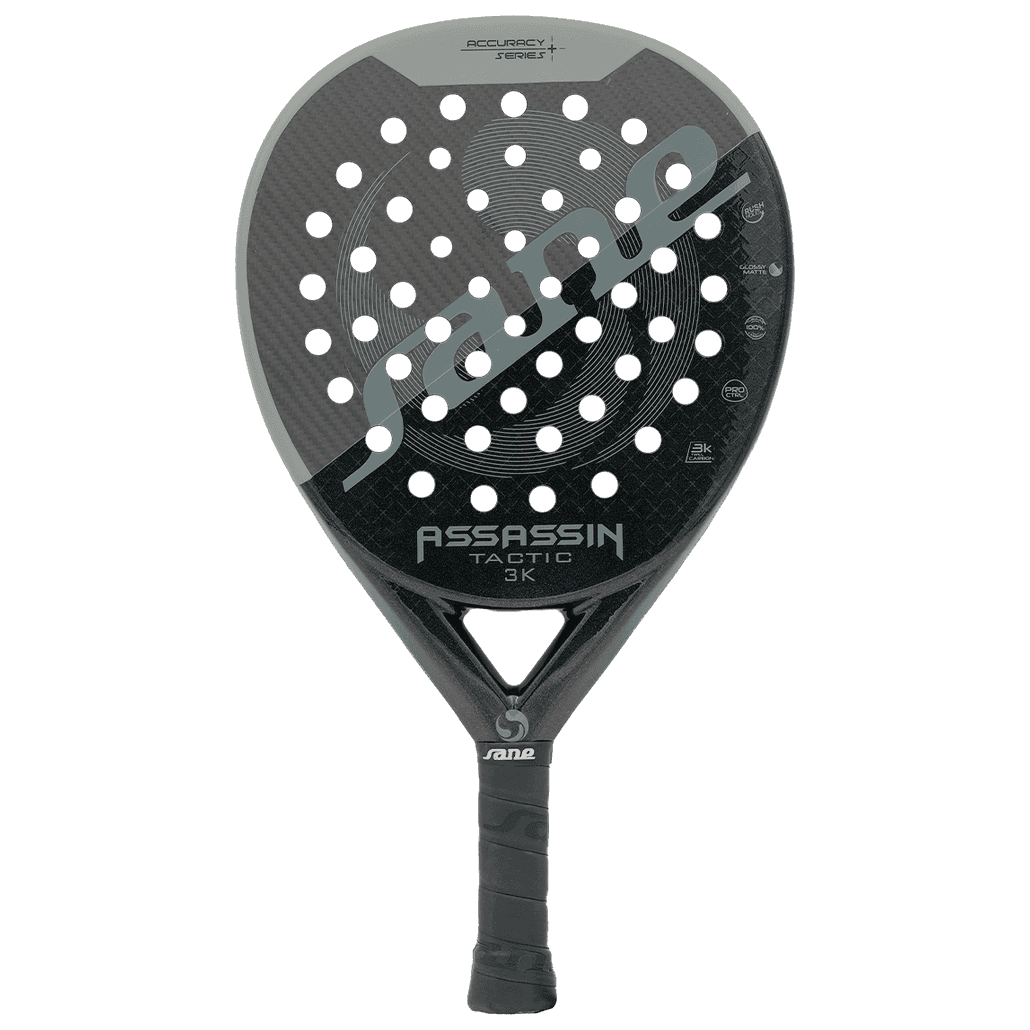
Sane Assassin Tactic 3K 2026 is a control-first racket with a dry, direct response and enough speed through the air to stay composed when exchanges get messy. Its teardrop shape and medium-hard feel point toward the player who wins points through placement, patience, and clean decisions rather than easy power.
I see it fitting an intermediate-to-advanced player who values a reliable bandeja, a firm block, and accurate lobs from the baseline. It does not hand out pace for free. That is the deal.
Technical analysis
Shape & balance
The teardrop profile gives the Assassin Tactic 3K a useful middle ground: it is more forgiving than a demanding diamond, but it does not feel vague or overly soft at contact. The sweet spot sits fairly centered, which is noticeable when I am defending rushed balls or catching volleys slightly outside the middle.
Its medium balance keeps the head from dragging during fast preparation. That helps particularly in transition, where I can change from a defensive position into a compact volley without feeling late. It is a quick racket, though not a feather-light one; players who rely on a very head-light racket for wristy flicks may still notice some substance through the frame.
Materials & construction
The 3K carbon faces give the racket its firm, slightly dry character. Contact feels clean rather than cushioned, and I get clear feedback on whether I have struck through the ball properly. There is enough forgiveness for minor off-center contact, but the racket does not disguise poor timing.
The PRO-Ctrl core supports that controlled response. Ball exit is moderate rather than explosive, so it rewards a complete swing and good use of the legs. On slower balls, especially from deep in the court, I need to add my own acceleration. Players moving from a soft fiberglass racket may initially find it less lively.
On-court feel
Baseline play
From the baseline, this is a dependable racket for building the point. Blocks stay low and controlled, and defensive lobs are easy to direct because the face does not kick the ball unpredictably. I also like it on hurried off-the-wall shots: the centered sweet spot gives me a reasonable margin when contact is not clean.
The limitation is depth on passive defense. If I simply present the racket to the ball, it will not always carry deep enough to push opponents back. A compact but active stroke works much better. This is control through input, not automatic rebound.
At the net
At the net, the quick handling is one of its strongest traits. In rapid volley exchanges, I can keep the racket in front and redirect without fighting a top-heavy balance. It is particularly good for firm blocks, controlled volleys into the feet, and a short chiquita when the opening appears.
I would not call it a naturally punishing volley racket. It can accelerate the ball, but it does not produce the heavy, effortless penetration of a power-oriented diamond. It asks me to hit through the ball rather than relying on the racket to do it.
Bandeja and víbora
This is where the Assassin Tactic makes the most sense. The predictable response lets me place a bandeja with confidence, whether I am looking for the side wall or a deeper ball through the middle. The balance also makes it easy to repeat the same preparation under pressure.
A víbora works well when I create racket-head speed myself, with enough bite and direction to keep opponents pinned. Flat smashes and x3 attempts are less convincing. On the right ball they are possible, but this is not a racket that turns average technique into an easy finish.
Conclusion
I would choose this racket for controlled, tactical padel: players who defend with intention, use lobs to regain the net, and prefer placement over raw force. It feels especially suited to the right-side player, although a patient left-side player can also get a lot from its speed and accuracy.
The trade-off is clear. You gain stability, maneuverability, and dependable direction on blocks and overheads, but give up easy ball exit and routine smash power. If your game depends on ending points with flat winners, there are more forceful options.
What other reviewers say
- PadelTestLabes
This test places it firmly on the control side: its dry response, centred sweet spot and mid-low balance help with placement on bandejas, blocks, lobs and hurried wall shots. The trade-off is limited free ball exit, so flat smashes and x3s require the player to create the pace.
- AvisPadelfr
The analysis finds it quick in fast volley exchanges and dependable for measured bandejas and transition shots, while retaining useful forgiveness on slightly off-centre contact. Smashes work on the right ball, but it is not designed to be a routine x3 weapon.
Switch Intelligence
Be the first to share where you switched from.
Community reviews
Real feedback from players who used this racket.
Add your review
To submit your review, log in first. You can still read all approved community reviews below.
Add review


