

Dunlop FX Hybrid Team 2026
A composed teardrop with a lively touch, quick hands, and enough bite to turn defense into measured attack without asking for a huge swing.
Our Take
Shape
Tear
Weight
360 - 370 gr
Touch
Medium
Core
Eva Pro
What we like
- Easy depth on compact swings
- Quick handling in net exchanges
- 3D texture grips *bandejas*
What we don't
- Lively rebound needs soft hands
- Little weight on fast *víboras*
- Little free smash power
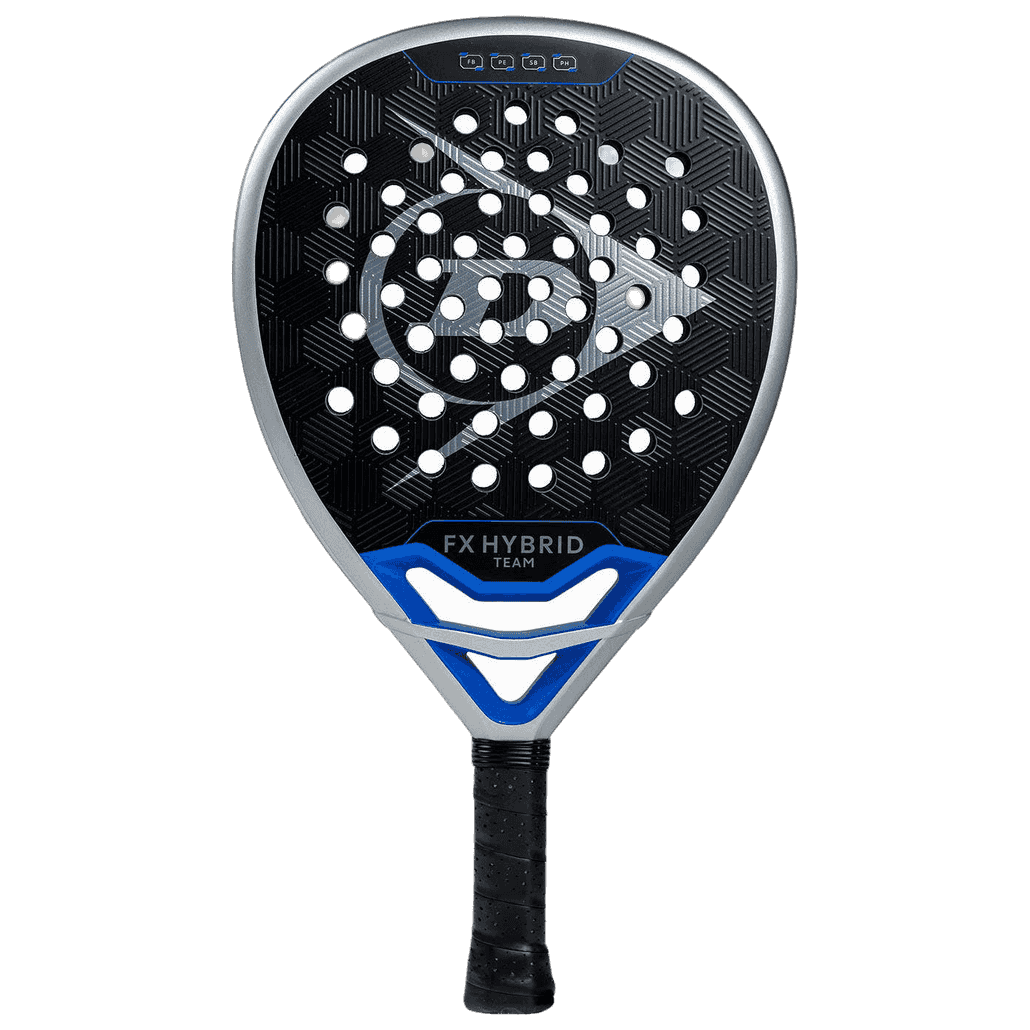
Dunlop FX Hybrid Team 2026 is a friendly all-court racket with a clear preference for control, easy handling, and a lively response. It does not ask me to force the ball to get depth, which makes it a reassuring option during messy defensive points.
The character comes from its teardrop shape and medium feel. I found it quick enough around the body and predictable through most phases of the point, although players who want a dry, hard impact will likely find the response too springy.
This is a racket for the intermediate player who wants to build points cleanly rather than finish them through brute force. It can attack, but it is not a weapon built around the smash.
Technical analysis
Shape & balance
The teardrop format places the sweet spot high enough to give some help on attacking volleys and overheads, without making the racket feel head-heavy or slow in defense. Its maneuverability is one of its strongest traits. On quick exchanges at the net, I can adjust the face late and still keep the ball under control.
That accessible balance also works well from the baseline. Defensive lobs come off with less effort than they do from a firmer, more demanding racket, and I did not feel the racket pulling my wrist down during repeated off-the-wall play. The trade-off is obvious: it does not carry the mass or concentrated punch that aggressive players want above the head.
Materials & construction
The listed EVA Pro core gives the racket its active ball exit. The response feels comfortable rather than harsh, with enough absorption to keep blocks and defensive contacts from becoming unpleasant. That comfort is useful over a long match, especially for players who do not enjoy very rigid carbon faces.
Dunlop does not specify the frame or face composition in the available data, so I would not invent a carbon story around it. What is clear on court is the relatively elastic response and the 3D surface texture. The texture gives the ball some extra bite on sliced shots, particularly when I slow the arm down and shape a controlled overhead.
On-court feel
Baseline play
From the back of the court, this racket is easy to trust. It produces depth on compact swings, helps when I am late on a block, and makes defensive lobs accessible without needing a huge follow-through. The sweet spot is generous enough that slight misses do not immediately punish the point.
Still, the rebound is lively. Against fast balls, I need soft hands and a stable racket face; otherwise, the ball can leave more quickly than intended. Players who prefer a muted, firm response for low-driven lobs and precise defensive placement may want something drier.
At the net
The FX Hybrid Team moves well through quick volleys and lets me change direction without fighting the balance. It is particularly comfortable for controlling pace: firm blocks, short angled volleys, and the occasional chiquita all feel available without overhitting.
The 3D texture is noticeable on a bandeja and víbora. I can create useful slice and keep the ball low after the glass, but the racket favors placement over outright penetration. A well-struck overhead carries enough weight, yet it will not produce the heavy, forcing ball of a stiffer head-heavy racket.
Smash
The smash is where its limitation becomes most visible. It responds cleanly and does not feel dead, but it does not add much free power when I try to finish from less-than-perfect positions. Players who rely on flat power smashes or want easy x3 acceleration will need to generate most of that speed themselves.
Conclusion
I would point regular intermediate players toward this racket if they value maneuverability, comfort, and a predictable response from defense to the net. It suits a player who builds points with placement, controlled volleys, and shaped overheads.
The trade-off is power. Its lively ball exit helps in defense, but it lacks the firm, explosive finish that aggressive smashers usually want. If your game depends on overwhelming opponents above the head, this is not the right tool.
What other reviewers say
- Pádel Análisises
The racket is described as an easy, versatile all-court option that moves smoothly between defense and attack, with comfortable, manageable handling. Its 3D texture helps on bandejas and slices, but outright finishing power is limited for aggressive smashers and the rebound may feel too lively for players wanting a drier, firmer response.
Switch Intelligence
Be the first to share where you switched from.
Community reviews
Real feedback from players who used this racket.
Add your review
To submit your review, log in first. You can still read all approved community reviews below.
Add review


