

Varlion Bourne Prisma Carbon Soft 2025
A demanding diamond that rewards early preparation with heavy finishing pace and a crisp, assertive response at the net.
Our Take
Shape
Diamond
Weight
345 - 360 gr
Touch
Medium-Hard
Core
SOFTCOLOR semi-hard EVA Core, 38 mm
Faces
Carrera 20K Carbon + fiberglass
Frame
Prisma Frame, bidirectional carbon tubular
What we like
- Penetrating, stable net volleys
- Heavy, direct smash response
- Strong bite on víboras
What we don't
- Selective high sweet spot
- Demanding late off-the-wall defense
- Limited passive block ball exit
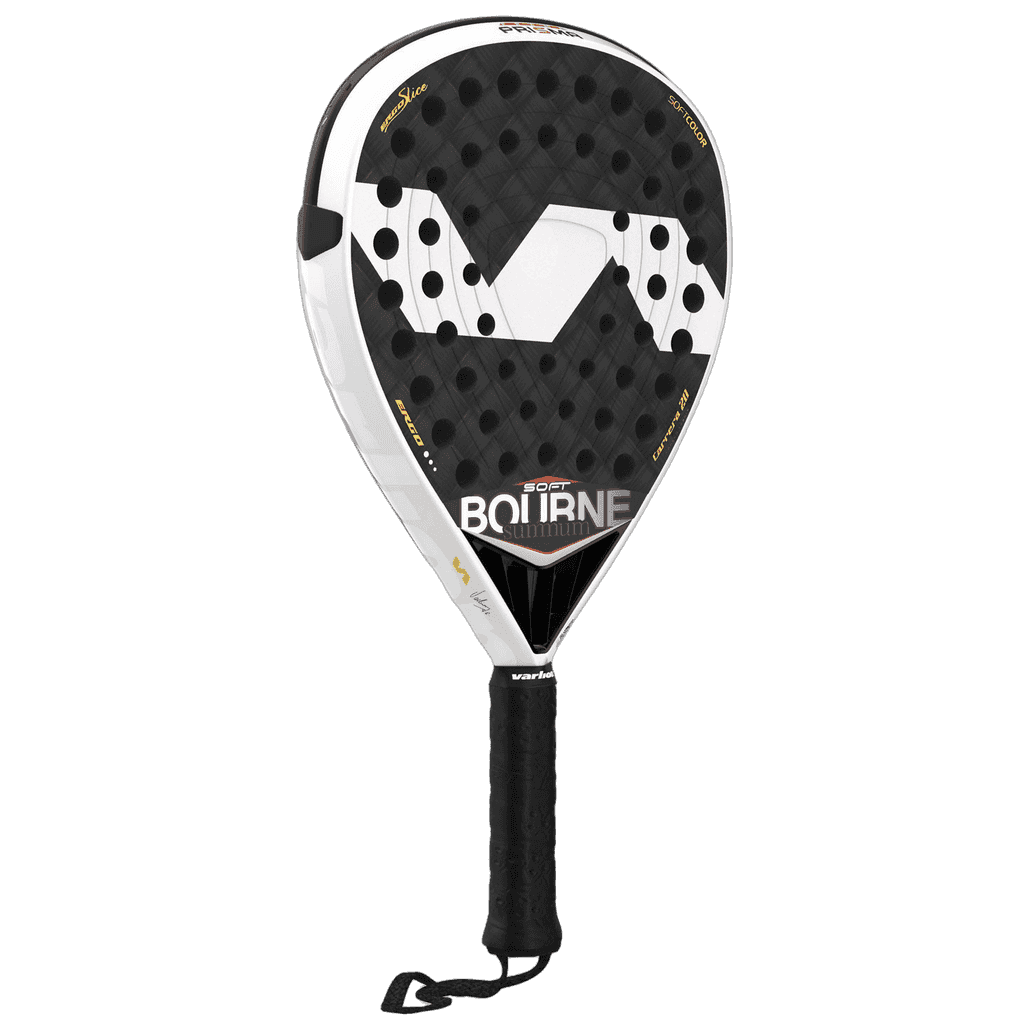
The Varlion Bourne Prisma Carbon Soft 2025 is an attacking racket with a serious edge: it wants me moving forward, taking the net, and finishing points rather than waiting comfortably at the baseline.
Its diamond shape and medium-hard feel give it a direct, compact response. There is power available, but it does not arrive for free. I need clean preparation and contact to get the most from it.
This is not a forgiving all-court racket for players who rely on easy ball exit in defense. It suits an advanced player who creates pace with their own swing and likes a firmer, more precise hit.
Technical analysis
Shape & balance
The diamond mold puts the sweet spot relatively high and makes the racket feel attack-oriented from the first volley. The balance is not wildly head-heavy, but there is enough mass through the upper part of the frame to make overheads and aggressive volleys hit with authority.
That setup also explains its limitation. Contact low on the face, especially on late balls after the glass, is less forgiving than with a round or lower-balanced racket. I would not choose it for lazy defensive exchanges or rushed blocks when my preparation is already behind.
Materials & construction
Varlion uses a Prisma carbon frame, Carbon Carrera 20K and fiberglass faces, and a SOFTCOLOR Core semi-hard EVA. On court, that construction translates to a firm but not brutally dry response. The fiberglass component softens the hit slightly, while the carbon keeps the face stable when I accelerate.
Ball exit is moderate rather than explosive. That is useful for players who prefer to control depth with their swing, but it means the racket will not rescue short defensive strokes. The face feels more rewarding when I hit through the ball with purpose.
On-court feel
Baseline play
From the baseline, I found the Bourne Prisma most convincing when I was active with my feet. Defensive lobs can be placed accurately if I get under the ball early, and low-driven lobs come off with a controlled, direct trajectory.
Late off-the-wall play is where it asks questions. The higher, more selective sweet spot means lateral pickups and low contacts need clean technique. A passive block can die short unless I give the ball some push. Players used to a softer racket with automatic rebound may need time to adjust.
At the net
At the net, this racket makes much more sense. Volleys come off firm and penetrating, with enough stability to redirect pace without the frame twisting around in my hand. I could press opponents with compact forehand volleys rather than needing a huge swing.
The response is particularly good for controlling the middle: firm blocks, sharp angles, and punchy volleys all feel natural. Touch shots such as a very delicate drop shot are possible, but they are not its strongest language. It prefers a more assertive contact.
Bandeja and víbora
The face gives good bite when I brush the ball, and the overhead balance helps carry pace through a bandeja or víbora. Reports on this model consistently point to its strong spin and direct overhead response, and that fits the racket’s construction and shape.
I liked it most when hitting an aggressive víbora toward the fence or driving a deep bandeja at the opponent’s feet. It rewards a committed swing. Trying to improvise an overhead from an awkward position is less comfortable.
Smash
The smash is its natural finishing shot. There is a high power ceiling, and clean contact produces a sharp, heavy strike without feeling overly springy. I still need timing—the sweet spot will not hide a mishit—but the racket transfers energy well when I catch it properly.
Conclusion
I would put the Bourne Prisma Carbon Soft 2025 in the hands of an advanced attacking player who values direct response, strong overheads, and stable volleys. It is built for taking initiative rather than absorbing pressure.
The trade-off is clear: less automatic rebound, a less generous sweet spot, and more work on low defensive contacts. If my game depends on easy recovery from the back court, I would look elsewhere. If I want a racket that rewards good preparation and lets me hit hard at the net, this one has a convincing identity.
What other reviewers say
- padel.howen
The review positions it as an advanced attacking racket, with a high power ceiling, direct punch on volleys and smashes, and strong spin potential on viboras and bandejas. The trade-off is a relatively high, selective sweet spot: late defensive balls and low or lateral contact demand active technique and preparation.
Switch Intelligence
Be the first to share where you switched from.
Community reviews
Real feedback from players who used this racket.
Add your review
To submit your review, log in first. You can still read all approved community reviews below.
Add review


