

Tecnifibre Wall Breaker 360 2024
A lively diamond racket that brings easy depth and bite to attack, provided you meet its high sweet spot on time.
Our Take
Shape
Diamond
Weight
360 gr
Core
EVA
Faces
Carbon, graphite
Frame
Carbon
What we like
- Easy defensive ball exit
- Stable blocking volleys at net
- Weighted *bandejas* and *víboras*
What we don't
- High sweet spot on lows
- Late wall exits feel demanding
- Lively response complicates touch
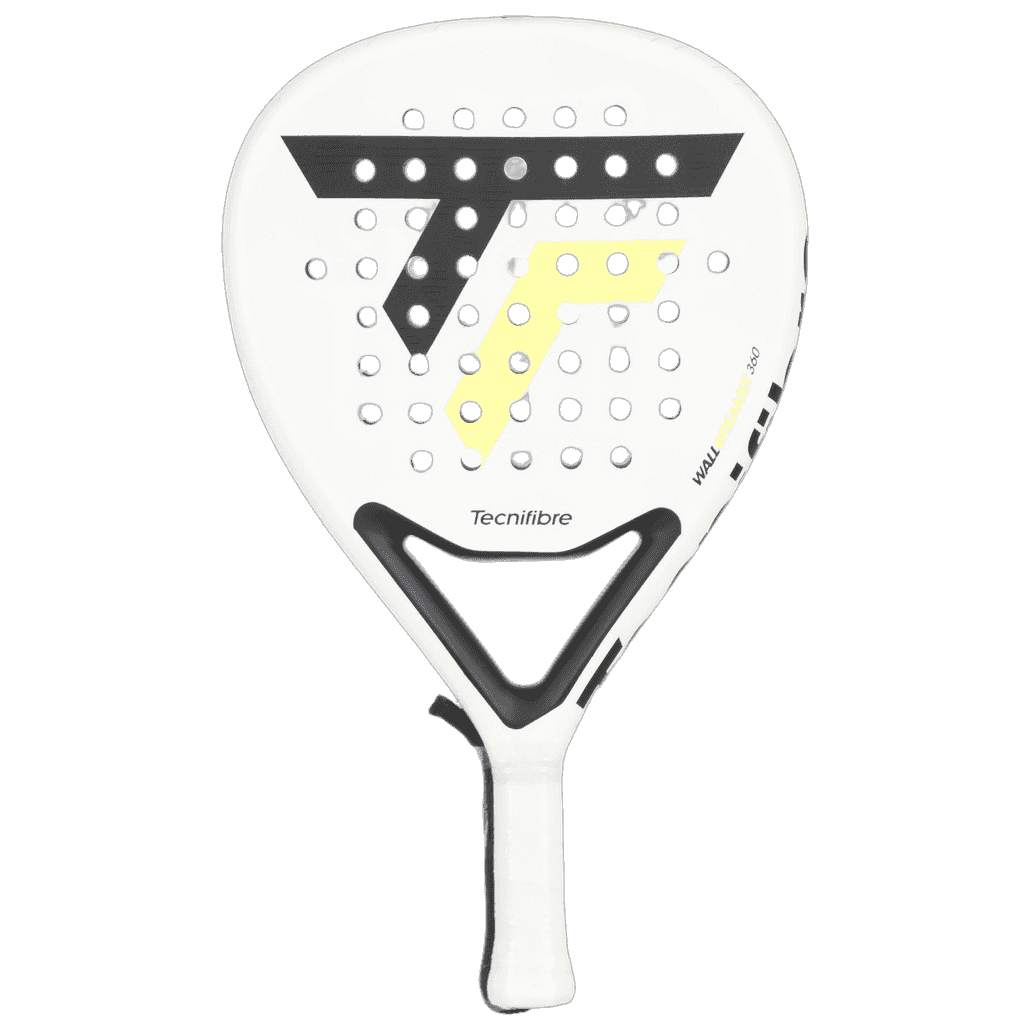
Tecnifibre Wall Breaker 360 2024 is an attacking racket with unusually easy ball exit for its diamond shape. It wants to turn defensive balls into depth, then reward you once you move forward and start accelerating overhead shots.
I found its character clear: it is not a precision-first racket. The response is lively, the balance leans toward the head, and it asks for preparation when the point gets fast.
It suits an intermediate-to-advanced player who generates their own pace and likes to pressure with volleys, bandejas, and smashes rather than relying on delicate touch.
Technical analysis
Shape & balance
The head-biased balance puts the useful part of the racket higher up. That helps the racket carry through the ball on attacking volleys and overheads, and it gives a defensive lob more length than I expected from a diamond model.
There is a cost. The sweet spot sits fairly high, so low contacts do not feel as forgiving as the strong ball exit might suggest. On a late wall exit or a ball below net height, I need to get my legs under the shot and prepare early. If I arrive late, depth control can disappear quickly and the racket feels slower to reposition.
Materials & construction
Tecnifibre uses a carbon frame, carbon and graphite faces, and an EVA core. The result is a stable structure with a soft-to-medium contact rather than a dry, hard-carbon response. That softer side is a big reason blocks and defensive returns can leave the racket with surprising depth.
The faces do not feel dead or overly muted. They give enough feedback to accelerate through the ball, although touch players may want a more linear response. I also would not buy this racket purely for spin: test feedback points to effective bite on sliced overheads, but some owners have found the spin less pronounced than expected. My read is that it rewards clean brushing technique rather than adding spin by itself.
On-court feel
Baseline play
From the baseline, the easy rebound is the main story. I can defend with a shorter swing and still send the ball deep, especially on blocks and higher balls coming off the glass. That is useful when I am under pressure and need to reset the point without forcing a big arm swing.
Fine placement is less automatic. Low-driven lobs, soft chiquitas, and short drop shots need a quiet hand because the racket can add more exit than intended. Off-center contact is manageable, but not as predictable as with a round, lower-balance control racket.
At the net
At the net, the Wall Breaker feels more at home. Blocking volleys are stable, and a compact punch volley carries well through the court. I can press the middle without feeling that the frame twists too much on firm contact.
Fast exchanges expose its limitation: it is not the quickest racket to flick around the body. Players who rely on rapid wrist adjustments or very soft angle volleys may find the head weight demanding.
Bandeja and víbora
This is one of its better areas. The racket helps me drive a bandeja deep and put weight behind a víbora without needing a huge swing. The higher sweet spot works in my favor when I contact the ball above shoulder height.
Smash
A clean smash has real finishing potential. The racket supplies accessible power and carries well through the ball, but it does not replace technique. Players without consistent timing will still struggle to turn every overhead into a winner.
Conclusion
I would choose the Wall Breaker 360 2024 for an attacking player who wants lively output, stable blocking, and more help on overheads than a control-focused racket provides.
The trade-off is clear: it asks more from low defensive balls, touch shots, and late preparation. If my game depends on surgical depth management and quick hand speed, I would look for a lower-balance alternative.
What other reviewers say
- PadelTestLabes
This test positions it as an attack-oriented racket with easy ball output, convincing smash weight and effective bite on spin-heavy víboras and bandejas. The trade-off is a high sweet spot and head-heavy feel that demand early defensive preparation and reduce precision on low balls and touch shots.
- AvisPadelfr
The review highlights very strong ball output and enough smash performance to finish points, while its softer contact helps on blocks and defensive shots. However, it rates control below power and says fast exchanges and off-centre contact require anticipation and consistent technique.
- Racketguide.comen
The small set of owner reviews is mixed: one beginner calls it stable with easy power, while other amateur users report trouble controlling depth and less spin than expected. That suggests its response may feel less intuitive depending on the player’s technique.
Switch Intelligence
Be the first to share where you switched from.
Community reviews
Real feedback from players who used this racket.
Add your review
To submit your review, log in first. You can still read all approved community reviews below.
Add review


