

Star Vie Shade 2027
A round, forgiving racket that makes the baseline feel calm and leaves enough pop for a clean finish at the net when needed.
Our Take
Shape
Round
Weight
350 - 370 gr
Core
S-EVA Flex
Faces
Aluminized X-Glass
Frame
Carbon
What we like
- Large sweet spot on blocks
- Easy defensive lob ball exit
- Quick handling for reaction volleys
What we don't
- Limited smash finishing leverage
- Less weight on aggressive volleys
- Soft response under full acceleration


Updated on 25 Sep (shipping cost not calculated)
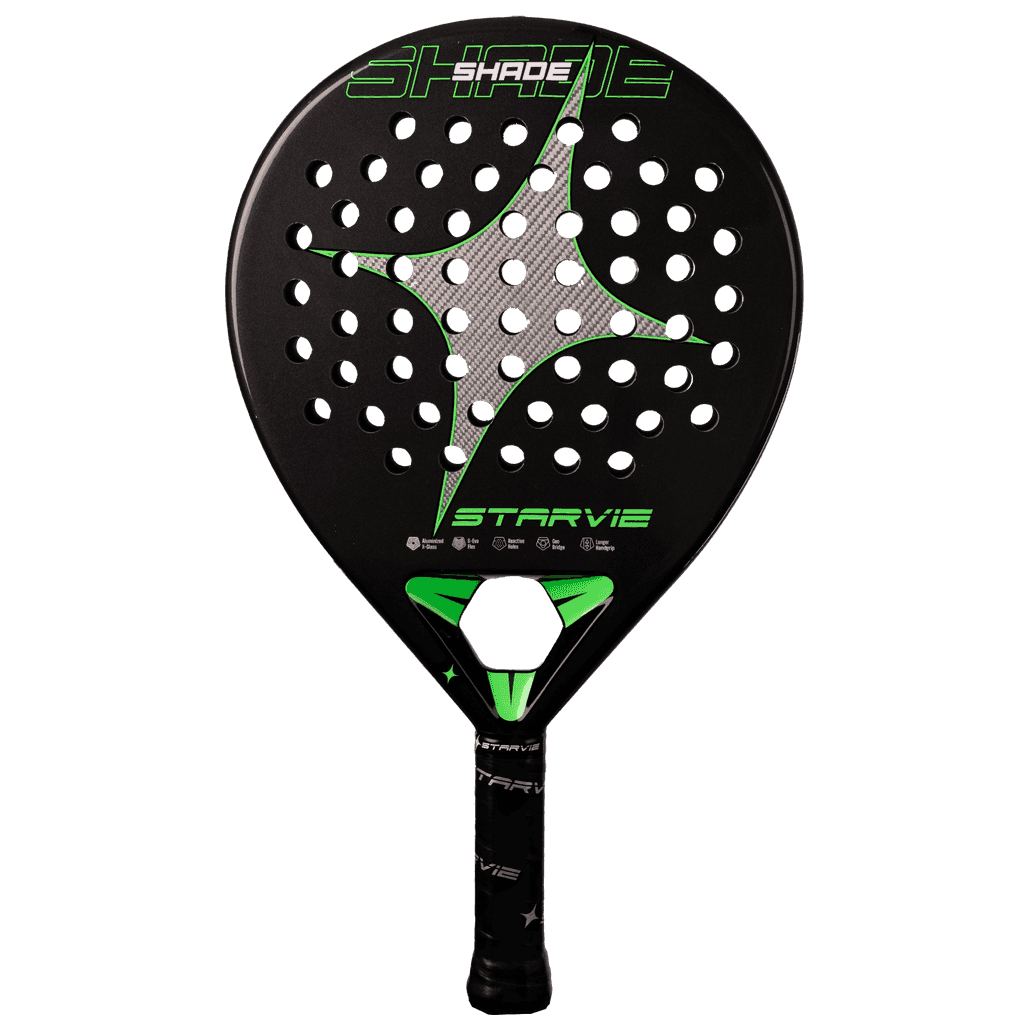
Star Vie Shade 2027 is a control-first racket with a forgiving, quick-handled personality. It is built around consistency rather than brute-force finishing.
I see it suiting players who construct points, defend with depth, and want a racket that does not punish slightly off-center contact.
That also sets the limit: this is not a racket for players who expect the frame to generate easy power on every smash.
Technical analysis
Shape & balance
The round shape puts the usable hitting area where most players need it: centrally and low enough to help from the baseline. Star Vie pairs that with what should be a very large sweet spot, and that matters more than a headline material when you are blocking fast volleys or returning awkward balls off the wall.
The listed maneuverability suggests a quick, manageable setup rather than a head-heavy weapon. In practical terms, I would expect it to come around easily on reaction volleys, defensive blocks, and late contact. It should feel cooperative in compact swings.
What it will not do is give the leverage of a diamond racket overhead. Players who rely on a high contact point and a heavy, finishing smash may find the Shade a little too restrained.
Materials & construction
The structure combines a carbon frame, Aluminized X-Glass faces, and an S-EVA Flex core. That is a sensible build for a racket aimed at comfort and ball exit rather than a hard, dry impact.
X-Glass should give the faces a more elastic response than a stiff carbon layup, while the Flex core points toward easier rebound on slower defensive shots. I would expect the contact to sit on the softer, more cushioned side of medium rather than feeling sharp or rigid.
The trade-off is precision under full acceleration. Softer, more reactive constructions can help the ball leave the faces with less effort, but they do not always give the same exact feedback as a firmer carbon racket when I really flatten out a volley or attack a high ball.
On-court feel
Baseline play
This is where the Shade’s design makes the most sense. The broad sweet spot and high rebound should help on defensive lobs, blocks, and controlled returns from the back glass. I would use it to reset points with height and depth rather than trying to force low-percentage winners from deep.
It should also be forgiving when contact arrives late, which happens often in fast exchanges. The racket’s easier ball exit can be useful, although players with a naturally loose swing may need to soften their hands on defensive blocks to avoid giving away a floating ball.
At the net
At the net, the Shade looks more suited to placement than intimidation. Quick handling should help on short reaction volleys and when changing direction through the middle. A chiquita or touch volley should be easier to shape than with a more top-heavy racket.
I would not expect the same penetrating weight on aggressive volleys that a harder, head-heavy model produces. You can still accelerate it, but the racket’s character favors moving opponents and maintaining pressure over ending the point with one hit.
Bandeja and víbora
The round profile should make overhead control approachable, especially on a measured bandeja where direction and depth matter more than raw speed. The Flex core may also help keep the ball moving through the court without needing a huge swing.
For a hard víbora, though, I would want more firmness and a more aggressive balance. The Shade should reward clean technique, but it is not built to make that shot naturally vicious.
Conclusion
I would look at the Shade 2027 as a racket for intermediate players and control-minded regulars who want easy handling, generous forgiveness, and helpful ball exit in defense.
Its strongest case is in organized point construction: lobs, blocks, touch volleys, and steady overheads. The compromise is clear. You gain comfort and margin, but give up some of the hard, decisive response needed for heavy volleys and finishing smashes.
Switch Intelligence
Be the first to share where you switched from.
Community reviews
Real feedback from players who used this racket.
Add your review
To submit your review, log in first. You can still read all approved community reviews below.
Add review


