

Sane Agressor Tactic Fiber 2026
A soft, lively teardrop that makes defense and spin feel easy, with enough head weight to add purpose to the smash.
Our Take
Shape
Tear
Weight
355 - 375 gr
Touch
Medium-Soft
Core
PRO-Ctrl
Faces
Fiberglass
What we like
- Easy baseline ball exit
- Broad sweet spot off walls
- Controlled bite on sliced overheads
What we don't
- Flat smashes lack finishing power
- Slow repositioning in fast volleys
- Short balls can float long
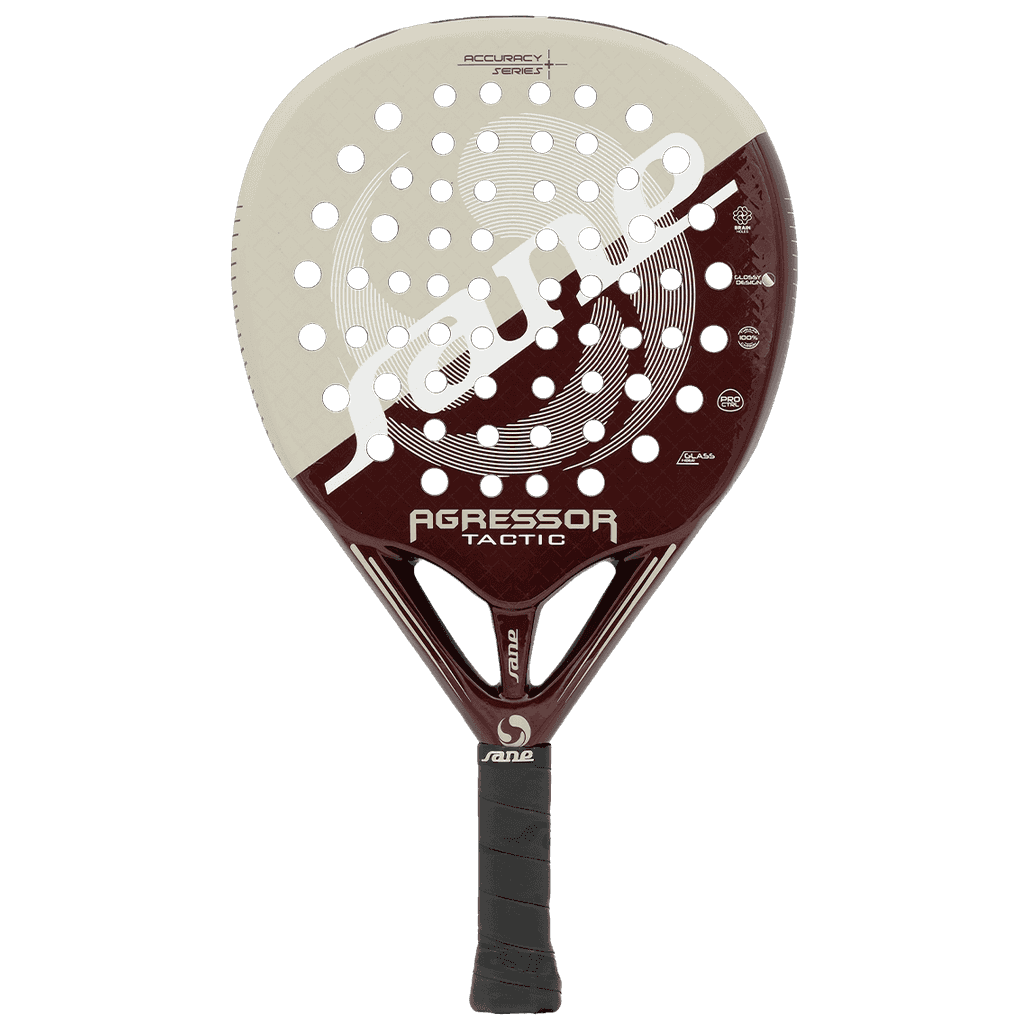
The Sane Agressor Tactic Fiber 2026 is a comfort-first racket with more attacking intent than its soft, forgiving response initially suggests. I see it as a strong fit for the intermediate player who wants easy depth from the baseline and a large margin for error without using a completely head-light frame.
Its tear shape and medium-soft feel give it a friendly, springy character. The ball comes off the face easily, especially when I am defending under pressure or playing with shorter preparation.
Technical analysis
Shape & balance
The tear mold places the sweet spot high enough to reward an attacking swing, while remaining much more accessible than a true diamond racket. Sane pairs that shape with a medium-high balance, so there is enough mass through the top of the racket to make overhead shots feel purposeful.
That balance is a trade-off. It helps me drive the ball through a bandeja or add weight to a smash, but it is not the quickest racket in frantic hand exchanges. If I arrive late to a fast volley, the head can feel a little slow to reposition.
Materials & construction
The fiberglass faces are a major part of the racket’s easy ball exit. They do not feel stiff or overly sharp on contact; instead, they flex enough to help the ball travel without demanding a big swing. That makes defensive blocks and controlled lobs less work.
Inside, the PRO-Ctrl core keeps the response lively rather than mushy. There is a lot of rebound, but not the dry, abrupt response I associate with harder EVA setups. Players who want a very firm face for flat punch volleys may find it too elastic.
On-court feel
Baseline play
From the baseline, this is where I would expect the Agressor Tactic Fiber to win people over. The broad sweet spot is noticeable on off-the-wall play, particularly when I am late and just need to send a solid ball back deep. It helps defensive lobs climb without forcing me to overhit.
The racket also works well for low-driven lobs and shorter tactical balls. I can soften the hand for a chiquita without the face feeling dead. Still, that generous rebound means touch needs attention: with a loose hand, short balls can float more than intended.
At the net
Volleys come off cleanly and with useful depth, especially when I block the ball rather than trying to force every winner. The forgiving face gives me some help on contact away from the center, which matters during quick exchanges.
What it does not provide is the brutally direct response of a harder carbon racket. Fast, flat volleys can lack the final penetration needed to finish the point outright. I would use placement and variation, not expect the racket to do all the damage for me.
Bandeja and víbora
The softer response and grippy face behavior suit sliced overheads well. I can work the ball on a víbora and keep a controlled trajectory on the bandeja, rather than feeling forced to hit through every ball.
A full smash has decent assistance from the balance, but flat power is not its main weapon. Players relying on effortless put-aways will want a firmer, more head-heavy option.
Conclusion
I would choose this racket for a player who values ball exit, a generous sweet spot, and calm defense, but still wants enough balance to play assertively from the net. It makes difficult baseline balls more manageable and gives tactical overheads a comfortable response.
The trade-off is clear: it is not a pure power racket, and it is not the fastest option for late reactions in rapid volley exchanges. Its strength is helping me construct points with depth, spin, and consistency rather than ending them with one flat hit.
What other reviewers say
- PadelTestLabes
The review highlights easy ball output, a broad sweet spot, and useful grip for sliced bandejas and spin shots, making it particularly comfortable for wall defense, lobs, and short tactical shots. Its medium-high balance adds weight to smashes, but flat power is not enough to finish points by itself and it is less forgiving when preparation is late in quick volleys.
Switch Intelligence
Be the first to share where you switched from.
Community reviews
Real feedback from players who used this racket.
Add your review
To submit your review, log in first. You can still read all approved community reviews below.
Add review


