

Sane Agressor Evolution Tactic 2026
A teardrop built to finish from overhead without turning defensive exchanges into a fight, with enough touch to keep the point ordered.
Our Take
Shape
Tear
Weight
355 - 375 gr
Touch
Medium
Core
PRO-Ctrl
Faces
Alutex
What we like
- Penetrating volleys with controlled pace
- Directed *bandejas* and *víboras*
- Forgiving sweet spot on blocks
What we don't
- Demands technique on late defense
- Less reactive in hand battles
- Limited effortless depth from baseline
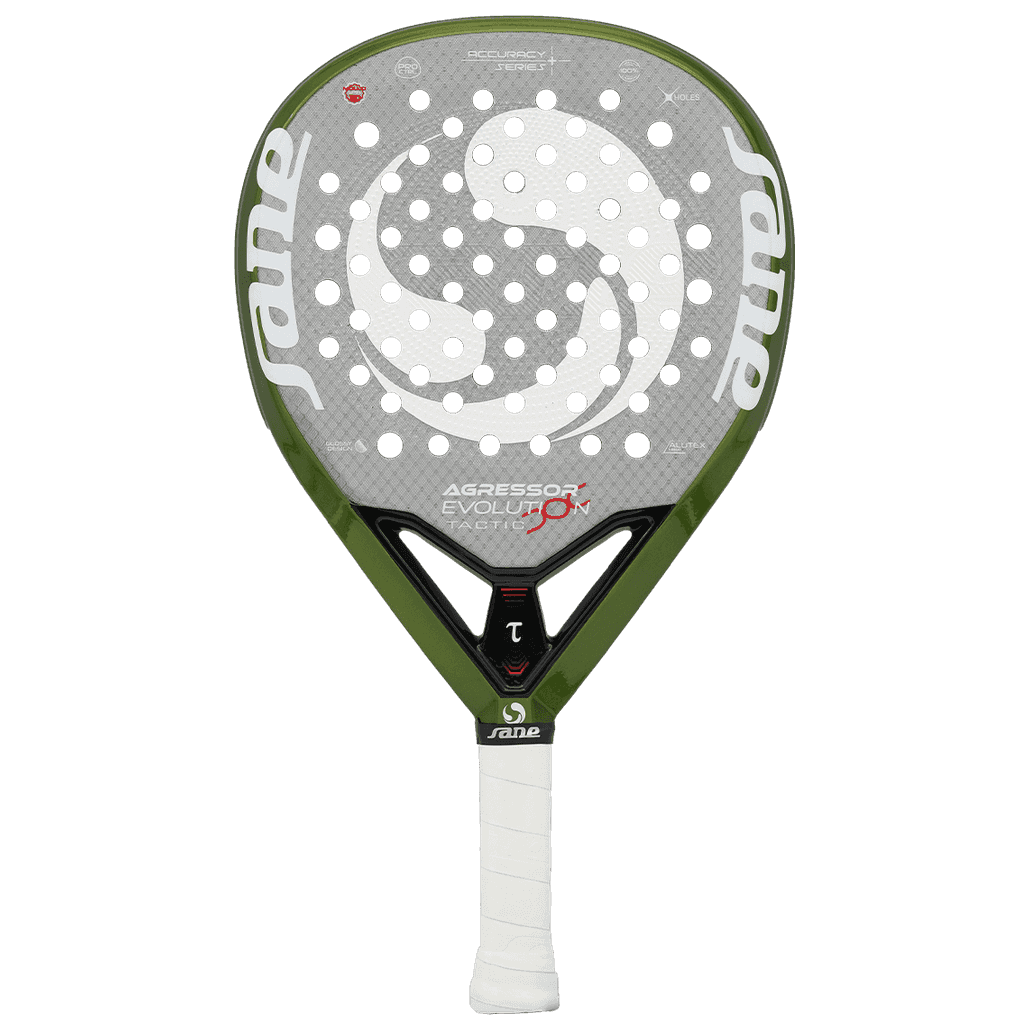
Sane Agressor Evolution Tactic 2026 is a versatile racket with an attacking edge and more control built into it than its name suggests. It wants to finish points, particularly through the middle and at the net, but it does not feel like a one-note cannon.
I found the teardrop shape gives it a useful middle ground: enough head presence to make overheads count, without the slow, top-loaded behavior of an extreme diamond racket.
Its medium feel is important. This is not a soft, springy racket that sends the ball back for you. You get a cleaner, more deliberate response, with enough ball exit to defend but a stronger reward when you accelerate through the shot.
Technical analysis
Shape & balance
The teardrop format places the sweet spot higher than a round racket but keeps it broad enough to avoid punishing slightly off-center contact. That matters on fast volleys and rushed blocks, where a more demanding attacking shape can twist too easily in the hand.
Balance feels oriented toward offense, though not excessively head-heavy. I could move it through quick exchanges at the net without feeling that the racket lagged behind my preparation. Still, players coming from a round, head-light control racket will notice the extra inertia on compact defensive swings.
This is not the quickest racket for reactive hand battles. It is more comfortable when I have time to set the face and punch through the ball rather than simply flicking it back.
Materials & construction
The Alutex faces give the impact a firm, connected feel rather than a muted one. I could feel the ball stay on the face long enough to direct it, particularly on controlled volleys and low-driven lobs, but the response becomes more forceful once I commit to the swing.
Sane pairs that surface with a PRO-Ctrl core, and the result is a medium response that avoids feeling either overly dry or overly bouncy. The core helps the racket remain usable from the baseline, where some power-focused models become vague unless the ball is struck hard.
There is no obvious trampoline effect here. Players who rely on effortless depth from a soft core may need to supply more of the pace themselves.
On-court feel
Baseline play
From the baseline, the Agressor Evolution Tactic feels stable on blocks and controlled counterattacks. The sweet spot is forgiving enough for off-the-wall play, and I liked the way it let me play a defensive lob with shape rather than launching the ball too high.
The trade-off is that passive defense is not its strength. On late contacts, especially against a heavy smash, it asks for a firm wrist and a clean racket face. It will not rescue poor preparation as easily as a softer, round control racket.
At the net
At the net, this is where the racket makes the most sense. Volleys come off with good penetration, and the medium touch gives me enough feedback to vary pace instead of flattening every ball. I could press opponents with a deep volley, then take pace off for a short chiquita.
Its maneuverability is solid rather than exceptional. In very quick exchanges, the balance can feel a little more demanding than a lighter-handling racket, but the payoff is a more substantial ball when I catch the volley cleanly.
Bandeja and víbora
The higher contact zone works well on the bandeja and víbora. I found it easy to produce a firm, directed overhead without having to overhit, and the face offers enough bite to bring the ball down after the glass.
A full-power smash is clearly available, but this racket is more convincing for players who build points with controlled aggression than those who want maximum free power from every overhead.
Conclusion
I would choose this racket for an intermediate-to-advanced player who attacks with intention, values a medium response, and wants more precision than a pure power model usually provides.
It rewards clean technique at the net and on overheads. In return, it gives up some easy defensive comfort and some of the lightning-fast handling that a round, head-light racket can provide.
Switch Intelligence
Be the first to share where you switched from.
Community reviews
Real feedback from players who used this racket.
Add your review
To submit your review, log in first. You can still read all approved community reviews below.
Add review


