

Head Vibe 2026
A soft, quick racket that makes defensive work and net reactions feel easy, though hard hitters will find its limits early.
Our Take
Shape
Tear
Weight
360 - 370 gr
Touch
Soft
Core
Foam
Faces
Fiberglass
What we like
- Easy depth from compact swings
- Quick handling on reaction volleys
- Soft impact dampens vibrations well
What we don't
- Twists on off-center heavy shots
- Limited smash penetration
- Smooth face offers little spin


Updated on 22 Sep (shipping cost not calculated)


Updated on 26 Oct (shipping cost not calculated)
Are you a store owner? Join our platform to be featured here.
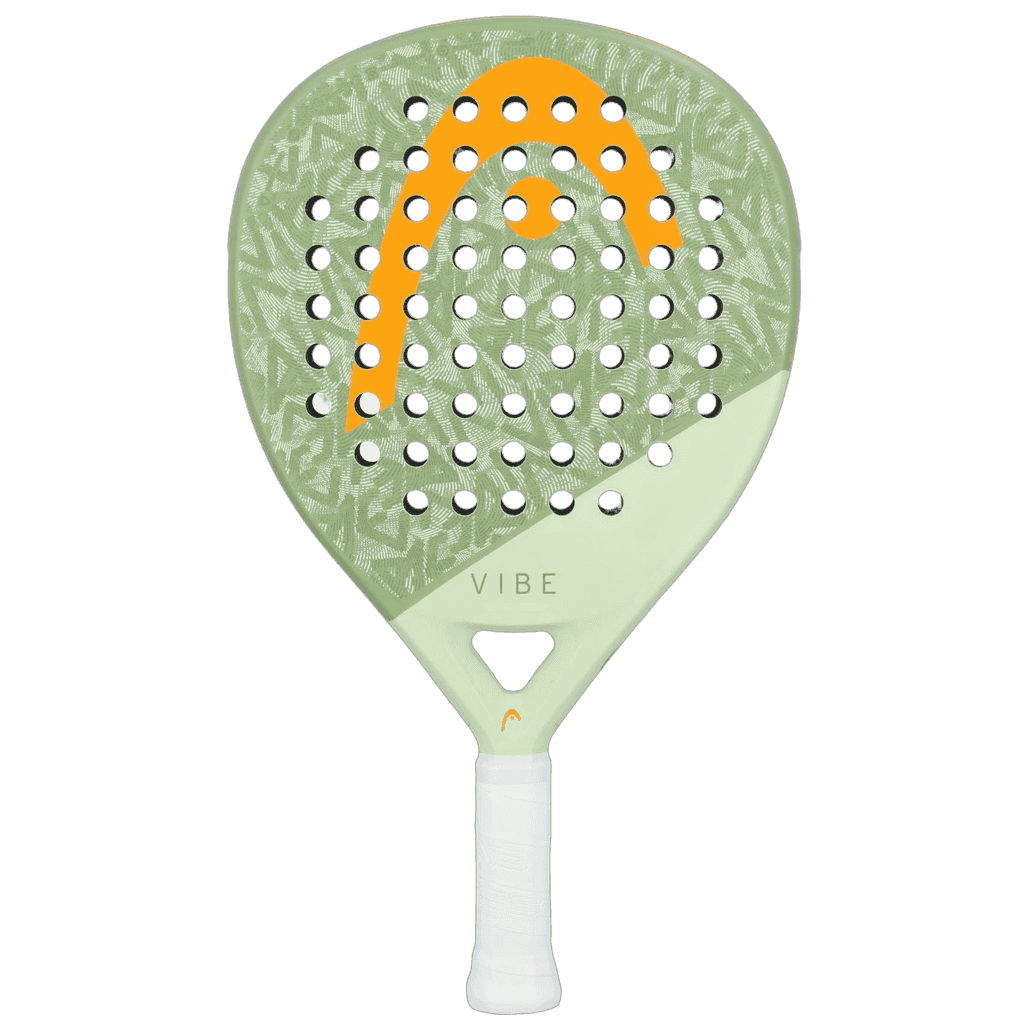
The Head Vibe 2026 is a forgiving, quick-handling racket built around easy depth and a notably soft response. It wants to help you stay in the point, not overpower it.
I see it as a sensible fit for recreational players and improving intermediates who value comfort, fast reactions, and a racket that does not demand a full swing to move the ball through the court.
That accessibility comes with a limit: once the pace gets heavy, this is not the most stable or precise platform.
Technical analysis
Shape & balance
The teardrop shape gives the Vibe a broad enough hitting area without feeling slow through the air. Its balance feels contained rather than head-heavy, which matches its quick behavior in hand: I found it easy to get the racket into position on reaction volleys, blocks, and late defensive contacts.
That maneuverability is one of its strongest points. The trade-off is that there is not much extra mass behind the ball when you try to force the issue. Against a hard volley or a fast drive at the net, off-center contact can make the racket twist more than I would like.
Materials & construction
Head uses fiberglass faces with a FOAM core, creating the clearly soft feel that defines this racket. Impact is muted and comfortable, with effective vibration damping that should suit players who dislike a sharp, dry response.
Ball exit is generous. A compact swing produces useful depth, especially when defending or playing a controlled ball from below net height. Still, the soft construction also explains why the response becomes less exact under full acceleration. I would not expect the same directional certainty that a firmer carbon-faced racket can provide.
The face is smooth, too. It does not add much natural bite, so players who rely on heavy cut or side spin will need to create it themselves.
On-court feel
Baseline play
From the baseline, the Vibe is at its most cooperative. It helps on defensive lobs, simple blocks, and off-the-wall recoveries because the ball comes off the face without needing a large backswing. When I am late to the ball, that easy exit is useful.
It is less convincing when I try to drive aggressively through a narrow target. The racket has enough control at moderate pace, but hard swings and rushed contacts reduce its directional precision. It rewards calm placement more than force.
At the net
Quick exchanges are where the Vibe earns its keep. I can move it rapidly for reflex volleys and short blocks, and the soft impact takes some sting out of opponents’ pace. That makes it comfortable for players who are still building confidence at the net.
However, it does not feel especially planted against heavy hitters. A firm punch volley is possible, but I would not call it a racket for dominating the net through sheer weight of shot.
Bandeja and víbora
A controlled bandeja works well because the racket helps carry the ball deep without asking for much effort. The same is true of a defensive lob under pressure.
The víbora is more limited. The smooth face offers little assistance with spin, and the soft response does not give that crisp, cutting sensation I want when trying to make the ball dip sharply.
Conclusion
The Head Vibe 2026 makes sense for players who want comfort, easy ball exit, and fast handling in defensive and net situations. It is especially friendly for someone progressing beyond a beginner racket but not looking for a demanding, stiff response.
What you give up is clear: maximum smash penetration, stability against heavy pace, and spin support. I would choose it for keeping rallies organized and making padel feel easier, not for finishing points with brute force.
What other reviewers say
- padel.howen
This review finds it soft, quick and comfortable, producing easy depth from compact swings and helping in recreational defense. Under heavy pace or full acceleration, it becomes less stable and less directionally precise, while the smooth face offers little spin assistance.
- Padel-Schläger-Vergleich.dede
After several weeks of testing, the reviewer highlights fast net handling, defensive lobs and strong vibration damping. They also find that the soft construction lacks finishing punch on smashes and feels imprecise or unstable as the pace rises.
Switch Intelligence
Be the first to share where you switched from.
Community reviews
Real feedback from players who used this racket.
Add your review
To submit your review, log in first. You can still read all approved community reviews below.
Add review


