

Enebe Response 3K 2024
A firm teardrop racket that rewards clean acceleration with biting volleys and authoritative overheads, while asking real work from defense.
Our Take
Shape
Tear
Weight
355 - 370 gr
Core
Black EVA HR9
Faces
3K Carbon
Frame
100% Carbon
What we like
- Direct, precise volley response
- Controlled *bandeja* and *víbora*
- Heavy smashes with acceleration
What we don't
- Demanding sweet spot off-center
- Defensive lobs need commitment
- Limited passive ball exit
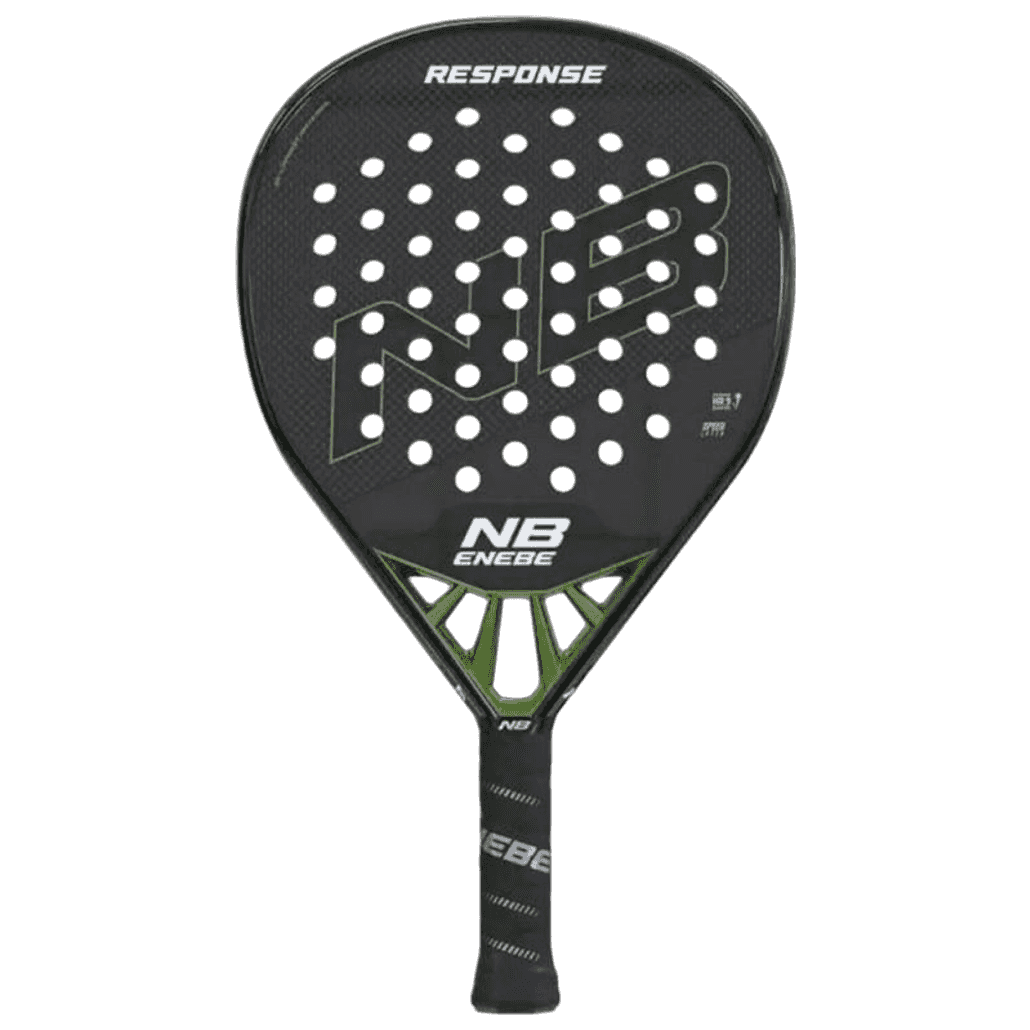
The Enebe Response 3K 2024 is a firm, attack-minded racket that rewards clean acceleration and decisive hands at the net. It is not built to hand you easy depth from the baseline; it wants you to create the shot.
I see it fitting an intermediate-advanced player who already has a reliable overhead game and prefers a direct response over a soft, forgiving one.
The character is clear: precision first, then power when you supply the racket-head speed.
Technical analysis
Shape & balance
Its teardrop shape gives the Response 3K a more balanced profile than a full diamond racket, but it still feels geared toward attacking situations. The balance is not wildly head-heavy, so I can move it through quick volley exchanges without feeling late, yet there is enough mass toward the upper half to make overheads carry weight.
That said, the usable sweet spot is not especially generous. Centered contact feels stable and accurate, while contact closer to the frame loses depth quickly. Players who regularly defend under pressure with improvised blocks will notice that difference.
Materials & construction
The 100% carbon frame, 3K carbon faces, and Black EVA HR9 core create a semi-hard feel with a crisp, fairly dry response. There is very little delay at impact. I can tell immediately whether I have struck the ball cleanly, which is useful for direction on volleys but less pleasant when I am stretched wide or late on an off-the-wall ball.
Ball exit is moderate rather than springy. The racket does not launch the ball on its own, and that is central to its personality. With a complete swing, it transfers energy well; with a short, passive stroke, it can feel underpowered.
On-court feel
Baseline play
From the baseline, I need to work more than I would with a softer EVA racket. Defensive lobs require a committed lift through the ball, especially when returning a fast volley or digging out a low ball after the glass. A lazy defensive lob can sit short.
The upside is control when I have time. Low-driven lobs and directional blocks are accurate because the face does not overreact. Still, this is not a racket for players who rely on free rebound to escape defense.
At the net
At the net, the Response 3K makes much more sense. Firm volleys come off direct and predictable, with enough stability to press the ball through the middle or toward the feet. I particularly liked the way it handles compact punch volleys: the face stays composed, and I can place the ball without needing a huge swing.
Touch shots demand softer hands. A drop shot or chiquita is possible, but the firmer face gives less automatic cushioning than a softer control-oriented racket.
Bandeja and víbora
This is one of its strongest areas. On the bandeja, I can drive the ball deep with a clean, controlled trajectory, while the víbora benefits from the direct face and firm contact. The racket responds well when I accelerate through the shot rather than guide it.
It does punish poor timing, though. Contact outside the sweet spot feels noticeably less solid, and the ball loses penetration.
Smash
The smash has real finishing potential, but it is earned power, not free power. When I accelerate properly and strike high and centered, the Response 3K produces a heavy, decisive ball. If my technique is incomplete, it will not rescue the shot.
Conclusion
I would put the Response 3K in the hands of a player with established technique who likes to take ownership of the net and build points through firm volleys, bandejas, víboras, and aggressive smashes.
The trade-off is comfort. Its semi-hard construction, moderate ball exit, and demanding sweet spot make it less friendly in rushed defense and less forgiving on off-center contact. For players who want a direct racket that tells the truth about their strike, that is part of the appeal.
What other reviewers say
- PadelTestLabfr
This test portrays it as a firm, very direct racket: it is precise on volleys, bandejas and víboras, and delivers strong smashes when the player accelerates properly. The trade-off is limited defensive help, a demanding sweet spot, and clear punishment on off-centre contact.
- Zona de Padeles
It presents this as the firmer Response version, with a semi-hard feel and a clear attacking focus near the net. According to the analysis, players need established technique to get the most from it.
Switch Intelligence
Be the first to share where you switched from.
Community reviews
Real feedback from players who used this racket.
Add your review
To submit your review, log in first. You can still read all approved community reviews below.
Add review


