

Dunlop FX Lite 2026
A light diamond that brings quick hands and easy ball exit, with enough punch to finish points before precision becomes the demand.
Our Take
Shape
Diamond
Weight
350 - 360 gr
Touch
Medium
Core
Soft EVA
Faces
12K Carbon
What we like
- Fast net and overhead preparation
- Easy smash acceleration and ball exit
- Quick blocks and defensive lobs
What we don't
- Less stable against heavy pace
- Precision drops on off-center contact
- Lively response under hard volleys
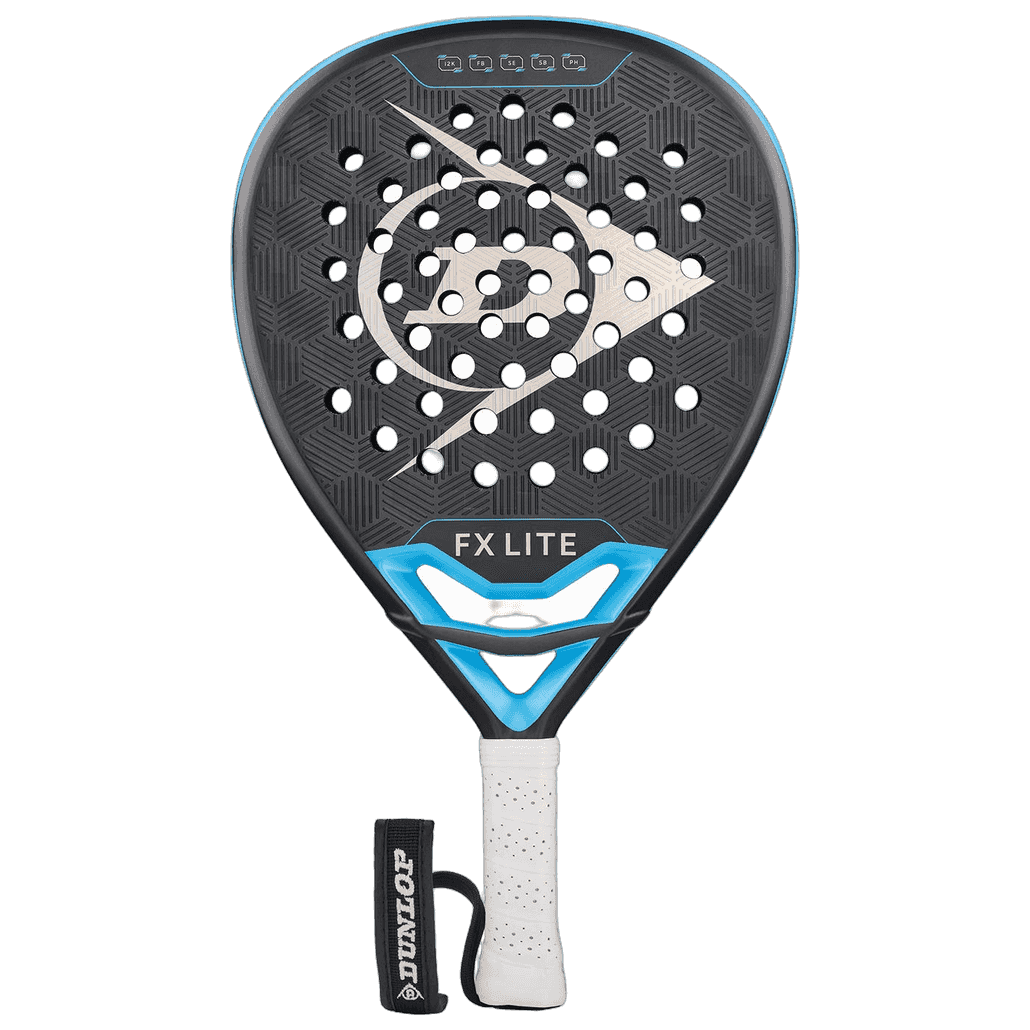
Dunlop FX Lite 2026 is a quick, attack-minded racket that gets through the air without feeling flimsy. Its Diamond shape points it toward offensive play, but the light handling keeps it more accessible than many diamond rackets.
I see it suiting an improving intermediate player who wants faster preparation at the net and easier acceleration on overheads. It gives you pace readily; it does not give you the planted, unshakable response of a heavier, more demanding racket.
Technical analysis
Shape & balance
The diamond mold places the sweet spot slightly higher, so the FX Lite rewards a more forward contact point. That is most noticeable on attacking volleys and overheads, where I can accelerate the racket head without feeling delayed in the preparation.
Despite the shape, it does not feel excessively head-heavy. Player feedback consistently points to its agile, light character, and that tracks with how I would expect it to behave in fast exchanges. It should be easy to bring into position for a quick block or a late defensive lob. The trade-off is stability: against a hard volley or a heavy smash, the frame is less likely to stay completely still than a more substantial racket.
Materials & construction
The 12K carbon faces give the racket a cleaner, more direct response than a fiberglass model. There is enough firmness to put speed through the ball, particularly when I commit to a compact volley or an overhead swing.
Underneath, the Soft EVA core adds a more forgiving layer and supports the strong ball exit reported in testing. The stated Medium feel seems fair: it is not a soft, cushioned racket, but neither is it harsh or overly dry. It should also be comfortable over longer sessions, with reviews noting useful vibration damping. Precision, however, is not its strongest technical trait. The response can become less exact when the ball arrives fast or contact moves away from the sweet spot.
On-court feel
Baseline play
From the baseline, the FX Lite’s speed is its main advantage. I would trust it for quick defensive blocks, reactive returns, and off-the-wall play where there is no time for a long setup. The core helps the ball leave the face without needing a big swing, which can make defensive lobs easier to lift.
What I would not expect is maximum authority under pressure. Advanced players have noted that it can surrender precision and stability in both defense and attack, and that matters most when absorbing pace. A low-driven lob needs clean timing; if I am late or catch the ball high on the face, the racket is less likely to rescue the shot than a steadier control-oriented model.
At the net
This is where the FX Lite makes the most sense. It is quick enough for rapid volley exchanges, and I can change direction late without fighting the balance. Short blocks, punch volleys, and a disguised chiquita should all benefit from that maneuverability.
There is real punch available, too. The carbon face and responsive core let me speed up a volley without a huge backswing. Still, players who build their net game around absorbing opponents’ power and returning a very heavy ball may find it a little too lively.
Bandeja and víbora
The fast handling should make this racket enjoyable for repeated bandeja preparation, especially for players still refining their overhead technique. It is easier to get the racket up and through the ball than with a more head-heavy diamond.
For a víbora, I would expect decent acceleration and a clean exit, but not the most locked-in directional precision on demanding contact. It favors speed and convenience over surgical placement.
Conclusion
I would put the FX Lite in the hands of intermediate players who want an offensive-shaped racket without the sluggishness and fatigue that can come with more demanding diamond models. It has enough punch for smashes and aggressive net play, while remaining quick in defense.
The compromise is clear. You gain maneuverability, ball exit, and a forgiving enough response for regular club play; you give up some stability and precision when the rally gets heavy. Advanced players who want a very solid platform for hard blocks and exact overhead placement may outgrow it.
What other reviewers say
- SnelPadelnl
In its test, the FX Lite felt notably light and responsive, delivering enough punch for smashes and attacking play without giving up speed. It also remained quick and controllable in defence, with effective vibration damping over long sessions.
- Racketguideen
Player reviews praise its light, manoeuvrable nature; one beginner also found it easy to use with a broad sweet spot. However, an advanced player felt it gives up too much precision and stability in both attack and defence under pressure.
Switch Intelligence
Be the first to share where you switched from.
Community reviews
Real feedback from players who used this racket.
Add your review
To submit your review, log in first. You can still read all approved community reviews below.
Add review


