

Black Crown Piton Blue 2026
A round racket with a generous sweet spot and a measured response, built to steady the baseline before moving forward.
Our Take
Shape
Round
Weight
355 - 370 gr
Core
Medium White EVA
Faces
3K Carbon
Frame
Carbon tubular frame
What we like
- Forgiving sweet spot on blocks
- Quick handling in volley exchanges
- Reliable defensive lob ball exit
What we don't
- Limited free speed on smashes
- Less penetrating volleys than head-heavy rackets
- Moderate bite on *víboras*
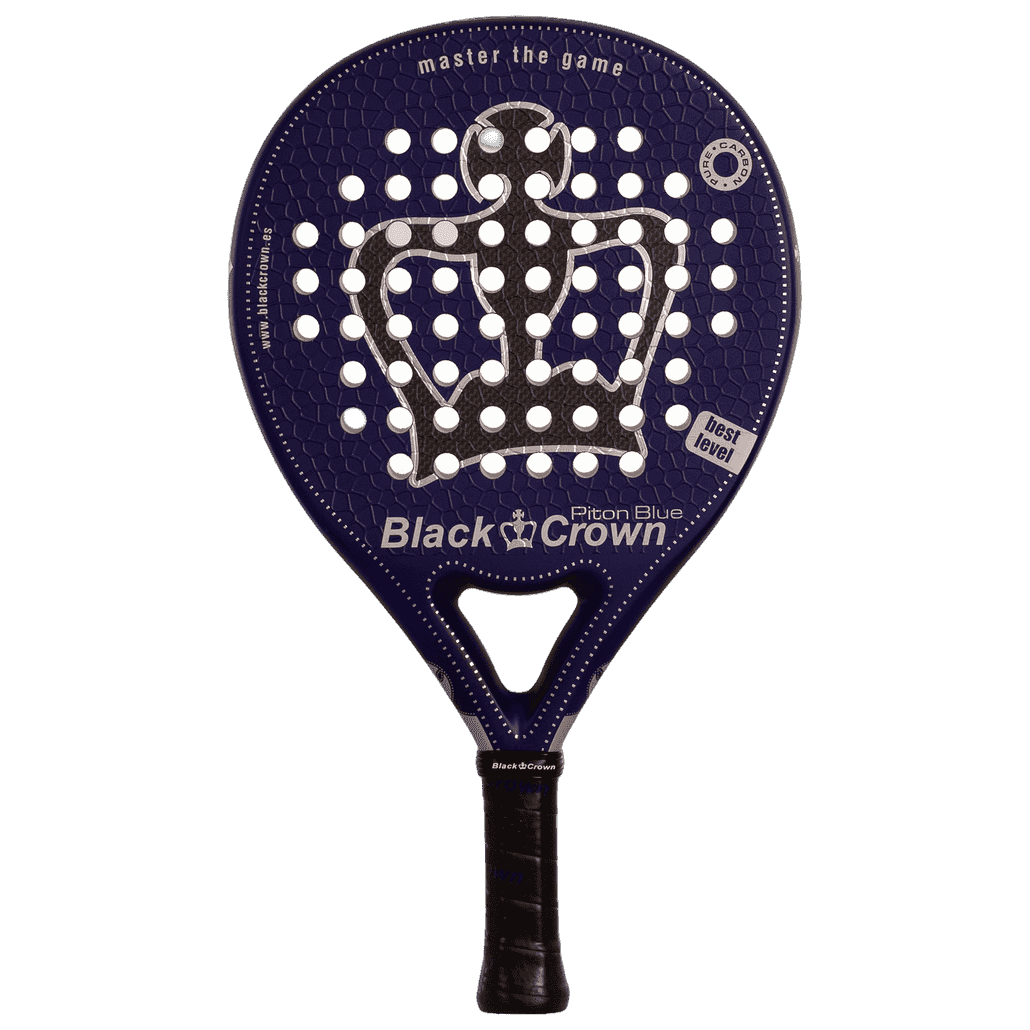
The Black Crown Piton Blue 2026 is a control-first racket with a forgiving hitting area and enough response to keep the ball moving from the back of the court. Its round shape tells the story early: this is about placement, recovery, and repeatable contact rather than brute-force finishing.
I see it fitting an intermediate player who builds points patiently and wants help in defense without using an overly soft, vague racket. It is not a power racket disguised as an all-rounder. You can attack with it, but you need to supply the acceleration.
Technical analysis
Shape & balance
The round mold puts the sweet spot high on its list of priorities. Contact feels easier to find on blocks, defensive lobs, and off-the-wall balls where you are not striking from a perfectly set position. That larger effective hitting area also makes it less punishing during fast exchanges at the net.
Balance appears restrained rather than head-heavy, which suits its maneuverability. I would expect quick preparation on volleys and easier racket positioning in defense, especially for players who do not want the head of the racket dragging behind the hand. The trade-off is clear: on a full smash, it will not provide the same automatic punch as a diamond-shaped, high-balance model.
Materials & construction
The construction combines a tubular carbon frame, 3K Carbon faces, and a Medium White EVA core. On paper, that points to a medium response: firmer and more direct than fiberglass, but not the dry, demanding feel of a hard-core attack racket.
That combination should give the Piton Blue a clean response on flatter shots without making touch shots feel disconnected. The medium EVA ought to provide useful ball exit when defending under pressure, while the carbon faces keep the racket stable when you press through the ball. Still, 3K carbon is not there to create a particularly sharp or aggressive bite; players who rely heavily on spin-loaded víboras may want a rougher, more attacking face.
On-court feel
Baseline play
From the baseline, this is where I would expect the Piton Blue to make most sense. The generous sweet spot should help on defensive blocks and on balls played after the glass, where clean contact matters more than raw speed. A medium core also gives you some assistance when lifting a low ball into a defensive lob.
It will reward compact technique. I would not try to force winners from deep with it, because the racket’s character is more about sending a controlled, deep ball back and earning a better position in the point. Low-driven lobs and directional changes should be more reliable than all-out counterattacks.
At the net
At the net, the quick handling should help with rapid volley exchanges and late reaction blocks. I would use it to place the ball, vary height, and play a short chiquita rather than trying to overpower every volley. The racket should feel stable enough through contact, but it will not produce the heavy, penetrating volley that a more head-heavy frame can generate with the same swing.
Bandeja and víbora
The Piton Blue looks better suited to controlled overheads than violent ones. A bandeja should be easy to direct because the round shape keeps contact predictable, and the medium response should let you take pace off the ball without it dying on the face.
For the víbora, I would keep expectations measured. It should be accurate and manageable, but players looking for a sharply accelerating, attacking overhead may find it too composed. This racket wants you to construct pressure, not end every overhead exchange immediately.
Conclusion
I would choose the Piton Blue 2026 for its forgiving contact, quick handling, and controlled medium response. It suits players who spend plenty of time defending, value consistency on the first volley, and prefer to win points through placement.
The compromise is power. It can finish a well-prepared smash, but it does not add much free speed when technique or timing is off. Aggressive players who want a head-heavy racket for dominant overheads will likely outgrow its calmer character.
Switch Intelligence
Be the first to share where you switched from.
Community reviews
Real feedback from players who used this racket.
Add your review
To submit your review, log in first. You can still read all approved community reviews below.
Add review


