

Babolat Technical Viper 3.0 2026
A hard-edged diamond racket that rewards clean contact with explosive pace, heavy spin, and serious authority at the net.
Our Take
The Court
1 reviewShape
Diamond
Weight
360 - 380 gr
Touch
Hard
Core
Hard EVA
Faces
3K Carbon
Frame
100% Carbon
What we like
- Explosive on aggressive shots
- Stable on heavy impacts
- Heavy volleys at the net
What we don't
- Sweet spot not generous
- Defense demands extra work
- Hard feel loads the arm



Updated on 15 Oct (shipping cost not calculated)





Updated on 26 Oct (shipping cost not calculated)
Are you a store owner? Join our platform to be featured here.
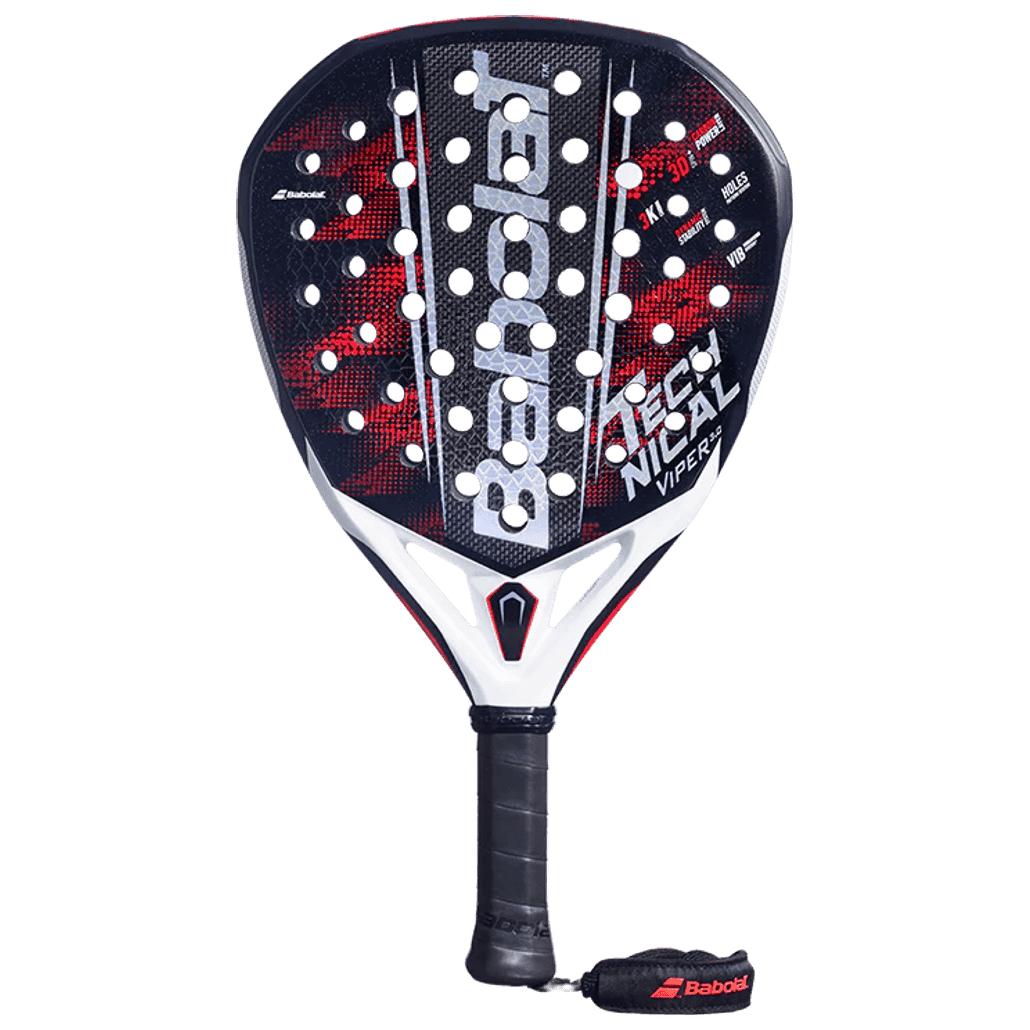
The Babolat Technical Viper 3.0 2026 is a hard-edged attacking racket with a very clear bias toward finishing points. I feel it straight away as a power-first frame: explosive when you accelerate, demanding when you don’t.
It’s built for players who live on the front foot. The reward is huge output on aggressive shots, heavy contact at the net, and a lot of weight through the ball. The trade-off is just as obvious: this is not a forgiving racket, and it will show you when your timing is late or your preparation is lazy.
Technical analysis
Shape & balance
The diamond shape and head-heavy feel define the whole experience. This is not a racket that tries to be friendly from the baseline. It wants to load the upper part of the frame, help you attack above the shoulder, and let you finish with authority.
That setup gives it a very offensive personality, but it also means the sweet spot is not generous. Centered contact feels clean and direct; off-center contact loses quality quickly. In quick exchanges, I wouldn’t call it slow, but it does ask for decent hands.
Materials & construction
Babolat uses 100% carbon in the frame, 3K carbon on the faces, and a Hard EVA core, and the result is exactly what I expect from that mix: a firm response, little deformation, and a crisp hit. The feel is clearly hard, with strong feedback on clean strikes.
That construction also explains why the racket feels stable on heavy impacts. It doesn’t twist easily when the ball comes hard, which matters a lot on aggressive volleys and big overheads. The downside is comfort. Over a long session, especially if you’re forcing defense, the firmness can load the arm.
On-court feel
Baseline play
From the back of the court, the Technical Viper is honest. On good swings, it sends the ball deep with pace and lets me hit an aggressive low-driven lob or counterpunch with real intent. The control is there, but it’s control that needs work from my side.
What it doesn’t give me is easy ball exit in awkward situations. If I’m late, stretched, or just trying to survive a defensive exchange, I have to do more of the job myself. That’s where the racket feels most demanding.
At the net
This is where it comes alive. Volleys come out heavy and fast, with a very direct response off the faces. I can press with it, close space, and keep the opponent under pressure without feeling the frame wobble.
The stability helps a lot in fast hands battles. Even so, it’s still a hard racket, so blocking pure pace takes clean technique. If I just put the racket there, the ball can shoot off faster than I want.
Bandeja and víbora
On the overhead side, it suits an aggressive bandeja and especially an attacking víbora. The ball comes off with good bite and enough speed to keep opponents pinned back. When I accelerate properly, the racket rewards me with a very sharp, penetrating trajectory.
It’s not as easy to shape these shots softly or disguise them. This is a racket that prefers intent over finesse. The output is better when I commit.
Smash
Smash is the natural habitat here. Flat finishing shots feel brutal when contact is clean, and the frame transfers energy very efficiently. I get the sense that the racket wants me to go for the point, not just play safe overheads.
That said, it punishes half-swings. If my mechanics are poor, the power doesn’t appear by magic. It asks for real technique, and that’s the price of the payoff.
Conclusion
I’d put the Babolat Technical Viper 3.0 2026 in the hands of advanced attackers who already know how they want to end points. If you like taking the net, hitting hard overheads, and living with a firm, precise response, it makes a lot of sense.
What you give up is comfort and forgiveness. Defense is more demanding than average, the sweet spot is not huge, and long rallies from the back can feel workmanlike rather than easy. This is a racket for players who accept that trade and want their frame to reward aggression first.
What other reviewers say
- PadelVerdicten
It is a highly specialized racket for advanced attackers: it delivers strong power, good stability, and a very aggressive ball exit, but it punishes players without solid technique. In defense and fast exchanges it feels demanding, and the sweet spot is not especially large.
- PadelMaden
The review presents it as a very aggressive offensive weapon, built for smashes, viboras, and dominant net play. It highlights power and spin, but makes clear that it is not a comfortable or forgiving racket for intermediate players.
- Dropcourten
It is described as a no-compromise power racket: ball exit is lively and consistent when contact is clean, and the stability technology helps keep the frame from twisting on heavy impacts. Comfort is helped by the vibration-damping system, but it still reads as an attack-first option.
Switch Intelligence
Be the first to share where you switched from.
Community reviews
Real feedback from players who used this racket.
1 review

Add your review
To submit your review, log in first. You can still read all approved community reviews below.
Add review


