

Babolat Counter Origin 2025
A soft, forgiving round racket that settles frantic defense and keeps the point simple, though its smash remains politely restrained.
Our Take
Shape
Round
Weight
345 - 355 gr
Touch
Soft
Core
Soft EVA
Faces
Fiberglass
Frame
Hybrid Frame (carbon-reinforced frame)
What we like
- Forgiving sweet spot on blocks
- Quick handling in net exchanges
- Cushioned off-the-wall defensive response
What we don't
- Limited smash ball speed
- Muted feedback on aggressive volleys
- Little bite on *víboras*


Updated on 26 Oct (shipping cost not calculated)
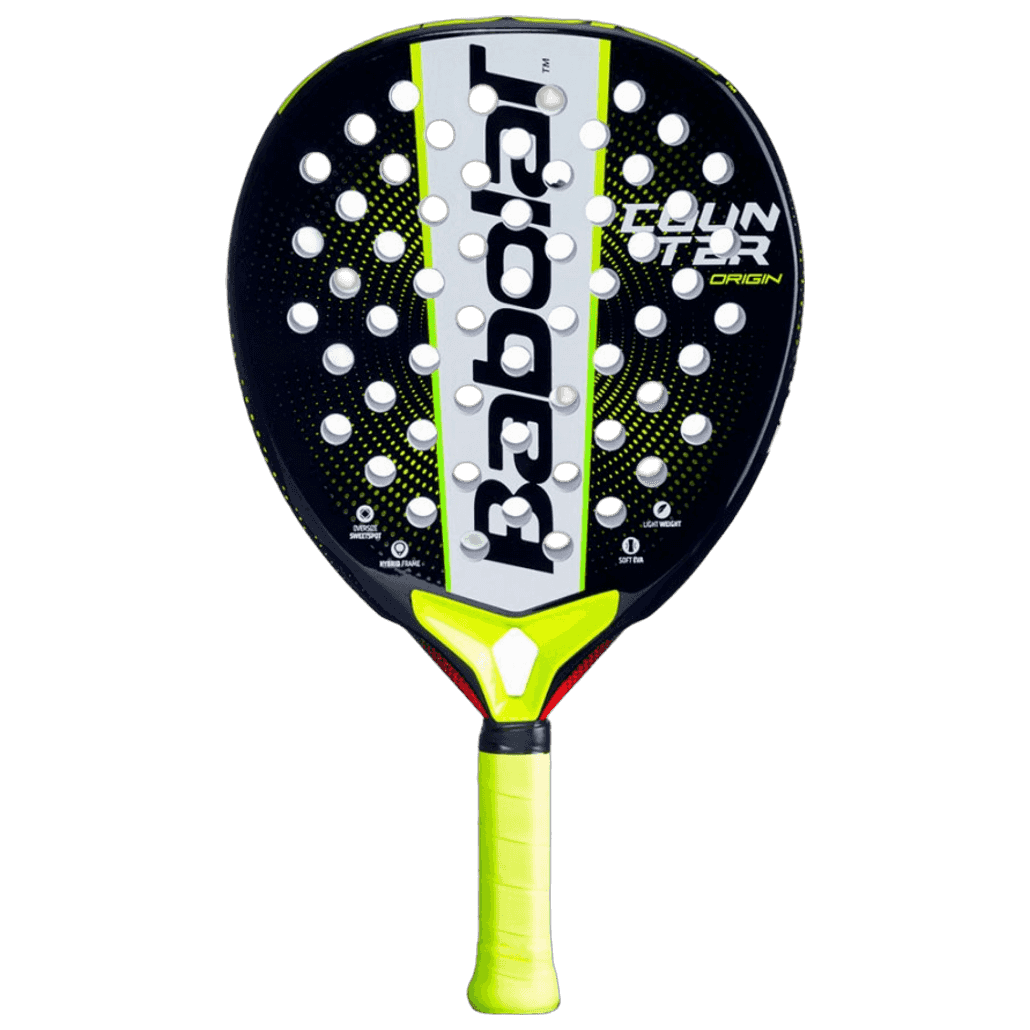
Babolat Counter Origin 2025 is a comfort-first racket built to keep the ball in play. It is quick through the air, forgiving when contact drifts away from center, and much more interested in helping you construct a point than ending one with brute force.
Its round shape and soft feel make it a friendly option for newer players, occasional competitors, and defensive-minded players who want less punishment from rushed contact. I would not choose it for an attacking game based on heavy overheads.
Technical analysis
Shape & balance
The round head gives this racket a notably broad sweet spot. In practice, that shows up on blocks, defensive lobs, and volleys hit slightly late or toward the outer edge of the face: the ball still leaves with enough direction to stay in the rally.
Balance feels manageable rather than head-heavy, which is a big part of why it moves so easily in transitions. I found that helpful when reacting at the net or changing from a defensive position into a quick volley. It does not pull the arm forward, but that same easy handling means there is less mass behind the ball when I try to accelerate through a smash.
Materials & construction
The Hybrid Frame combines a carbon-reinforced frame with fiberglass faces and a Soft EVA core. That construction produces a cushioned, filtered response rather than a sharp or dry impact.
Fast balls are easy to absorb. The racket takes some sting out of hard volleys and off-the-wall shots, which makes it less demanding when my timing is not clean. Ball exit is also generous at lower swing speeds; I do not need to force every defensive return.
The trade-off is a face that does not feel especially crisp. Players who like a firm carbon response, a more direct connection to the ball, or a racket that rewards aggressive acceleration may find it too muted.
On-court feel
Baseline play
From the baseline, the Counter Origin is at its most convincing. It gives me time and margin on defensive balls, particularly when I am under pressure and need to block the ball back deep rather than manufacture a winner. The forgiving sweet spot helps on improvised contacts after the glass, where a more demanding racket can punish small timing errors.
Depth is easy enough to find, but raw speed is not. A low-driven lob or a deep return will travel cleanly, yet I have to supply the pace myself if I want to push a stronger opponent backward.
At the net
Quick exchanges suit this racket. It comes around easily for compact volleys and feels stable enough for controlled blocks, without becoming cumbersome in the hand. I liked it most for placing the ball into space, playing a short drop shot, or holding a volley low rather than trying to overpower the opponent.
That said, aggressive punch volleys do not carry the same weight as they do with a firmer, more head-heavy racket. The ball leaves comfortably, but not heavily.
Bandeja and víbora
The soft, smooth face limits bite. I can direct a bandeja safely and use it to maintain net position, but I do not get much help carving the ball or making it skid after the bounce. The víbora is even less natural here: it lacks the crispness and surface grip that make that shot threatening.
Smash
A smash is manageable, not imposing. The racket will reward clean technique and placement, but it does not generate easy ball speed or make flat overheads feel explosive. Players developing an attacking game may outgrow it fairly quickly.
Conclusion
I would recommend the Counter Origin to players who value comfort, maneuverability, and a large margin for error. It works particularly well for learning court positioning, defending consistently, and gaining confidence at the net without fighting a demanding racket.
What you give up is clear: attacking weight, sharp feedback, and spin potential. It is a racket for building points and surviving difficult rallies, not for dominating them with the smash.
What other reviewers say
- PadelTestLabes
It is praised for cushioning fast balls from the back court, forgiving slightly off-centre contact and staying highly manoeuvrable on quick volleys. The trade-off is modest smash output and little bite on sliced bandejas or viboras because of the soft, smooth face.
- Padel-Pilot.dede
After several weeks of testing with beginners, the reviewer found that the round head keeps poorly centred shots in play and that the soft core filters vibration effectively. Power is plainly limited, so players seeking forceful smashes or improving quickly will soon reach its ceiling.
- SimplePadelen
The review sees it as a control-focused starter racket: it moves quickly, makes placement easier and offers comfortable contact in rallies and at the net. On smashes it gives manageable power, but not the pace needed for an attacking game.
- Racketguideen
In the player reviews, an amateur user calls it very comfortable but says it lacks ball speed; the aggregate rating is 3.5/5. Detailed comments are sparse, but they reinforce a comfort-first rather than power-first character.
Switch Intelligence
Be the first to share where you switched from.
Community reviews
Real feedback from players who used this racket.
Add your review
To submit your review, log in first. You can still read all approved community reviews below.
Add review


